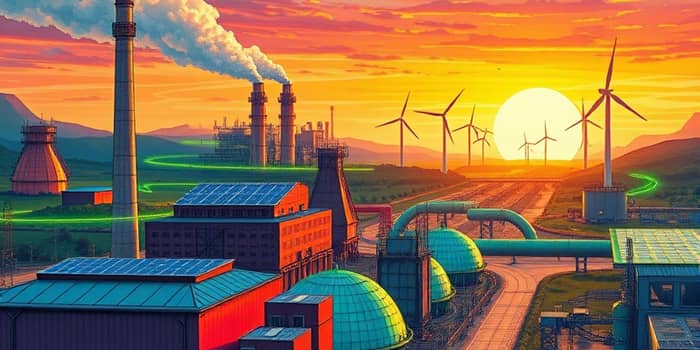
The global push towards sustainable growth has placed the heavy-emitting industrial sector at the forefront of decarbonization efforts. With governments, corporations, and investors aligning their strategies, the time is now to explore the vast potential in transforming these industries while securing long-term returns.
Industry contributes nearly one-third of global greenhouse gas emissions, driven by cement, steel, chemicals, aluminum, refining, pulp & paper, food & beverage, and glass production. Tackling these emissions is essential to align with the Paris Agreement’s goals.
In particular, the cement and steel industries have been labeled hard-to-abate sectors pose unique hurdles for technology and finance. Yet overcoming these challenges offers an unprecedented opportunity to unlock massive emissions reductions and support the broader climate agenda.
Meeting the the net-zero by 2050 target demands that heavy industries adopt new processes, alternative fuels, and carbon management solutions at scale. Every percentage point reduction in these sectors accelerates overall global progress.
Meeting decarbonization goals will require an incremental investment of $5–11 trillion by 2030 across supply chains. In Q1 2025 alone, the United States saw $19.8 billion in clean energy and industrial decarbonization funding, yet only $1.5 billion of that addressed industry-specific projects.
Texas has emerged as a leader, attracting $62.3 billion in new facility investments post-Inflation Reduction Act and creating nearly 13,000 jobs. However, overall investment growth was down 3% in Q1 2025 due to market uncertainty, highlighting the need for sustained policy clarity.
Several mature, investible technologies are gaining traction across heavy industries. Renewables integration and grid modernization serve as the backbone for cleaner operations. Green hydrogen is scaling rapidly, with investment growing at a CAGR exceeding 20%.
Biofuels and sustainable aviation fuel are emerging as versatile solutions with strong policy tailwinds. Carbon Capture, Utilization, and Storage (CCUS) projects are moving from pilot to full scale, particularly in cement and steel hubs along major industrial corridors.
Asia-Pacific represents the largest addressable market, driven by rapid industrialization and urban growth. Europe leads in policy-driven deployment of green hydrogen and CCS hub development.
In North America, the U.S. Midwest and Gulf Coast host major steel, chemical, refining, and cement facilities pursuing hydrogen-ready retrofits and carbon storage projects. Canada’s British Columbia has become a focal point for hard-tech commercialization through programs like NorthX.
Decarbonization delivers more than emissions cuts. Companies realize significant cost savings through improved energy efficiency and waste reduction, while streamlining operations. Early adopters strengthen their market position and access global supply chains with stringent sustainability requirements.
Furthermore, the transition supports job creation. Since the Inflation Reduction Act’s passage, over 2,300 new clean energy and manufacturing facilities have created tens of thousands of operational jobs, illustrating the direct socioeconomic benefits.
The coming decade will see the greatest value growth in electricity networks, sustainable vehicles, and advanced storage. Incremental investments in heavy industry fuel switching and energy efficiency will compound global decarbonization impact.
Emerging niches such as direct air capture, low-carbon retrofit technologies for existing plants, and next-generation bioenergy solutions present high-impact opportunities. Alignment with public incentives and evolving regulatory frameworks will be crucial to de-risk these bets.
Investors and stakeholders must act now to capitalize on the transformative potential of decarbonizing heavy industries. As policy, technology, and market dynamics converge, the opportunities to achieve significant returns and drive global emissions reductions have never been greater.
References