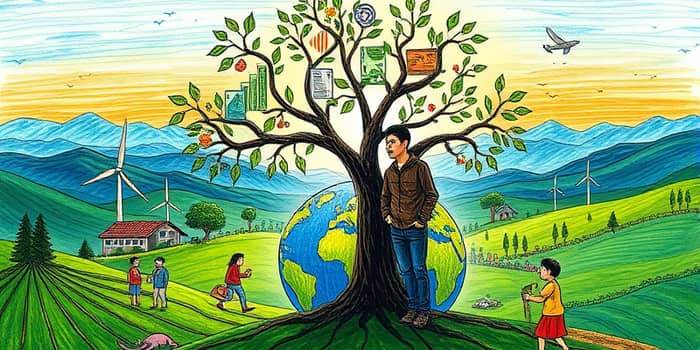
In a world where financial stress can overshadow purpose, a holistic model offers a transformative path. By weaving together personal values, community impact, and environmental stewardship, this approach elevates money from mere currency to a medium for living out values.
Holistic financial wellness aligns monetary choices with individual beliefs, collective well-being, and planetary health. Rather than focusing solely on accumulation, it emphasizes long-term health for individuals and the planet.
This perspective views money as a tool to support life goals, foster security, and drive positive change in society. Over recent decades, financial advisors and innovators have expanded definitions to include ecological and social dimensions.
Several frameworks highlight four core pillars that guide a comprehensive strategy:
By balancing these pillars, individuals can move from reactive money management to proactive wealth stewardship.
At the heart of this model lies the conviction that money choices should reflect what matters most: family, community, or the environment. Whether allocating funds to education, charitable giving, or sustainable ventures, each dollar becomes an expression of purpose.
This alignment fosters a sense of fulfillment, as resources are channeled to causes that resonate personally and socially. The result is a deeper connection between finances and meaning.
Traditional financial advice often centers on wealth accumulation and risk mitigation. A holistic approach shifts the narrative toward autonomy, mental health, and life satisfaction. It recognizes that reducing stress and enhancing life balance can be more valuable than maximizing returns.
Stress related to money ranks highest for 73% of Americans, according to recent surveys. Addressing financial anxiety through security, clear goals, and community support is a powerful step toward lasting well-being.
Innovation in financial wellness goes beyond new apps or platforms. It embraces systemic thinking from ecology, behavioral science, and economics to build regenerative, equitable financial systems.
Sustainable and impact investing—guided by ESG (Environmental, Social, Governance) criteria—has seen dramatic growth. Global ESG assets reached $35 trillion in 2020 and are projected to surpass $53 trillion by 2025.
Behavioral nudges, such as defaulting retirement plans into sustainable funds, are making better financial choices more intuitive for millions.
Financial wellness does not exist in isolation. It influences mental health, impacts relationships, and can support environmental stewardship. When individuals simplify lifestyles and prioritize experiences over material excess, resources flow toward deeper connections and community engagement.
This ripple effect strengthens neighborhoods and contributes to broader societal resilience.
Adopting this comprehensive mindset requires intentional action. Key best practices include:
By combining disciplined habits with value-driven objectives, individuals can navigate economic shifts with confidence.
While promising, the holistic model faces obstacles at both personal and systemic levels:
Addressing these challenges involves ongoing learning, transparent reporting, and advocacy for supportive policies.
Holistic financial wellness draws on distributive justice, intergenerational equity, and industrial ecology theories. It calls for collaborative action among economists, scientists, and policymakers to reshape systems toward equitable prosperity.
Technology—from advanced financial apps to AI-driven advisors—will continue to democratize access to holistic planning tools. As demand for purpose-driven finance grows among millennials and Gen Z, institutions will be compelled to innovate responsibly.
Ultimately, a holistic approach to financial wellness invites us to reimagine prosperity. By integrating personal, communal, and planetary health into every decision, we can forge a future where innovation serves both people and the planet.
The journey begins with a single choice: to view money not as an end, but as a powerful means to live with intention, compassion, and creativity.
References