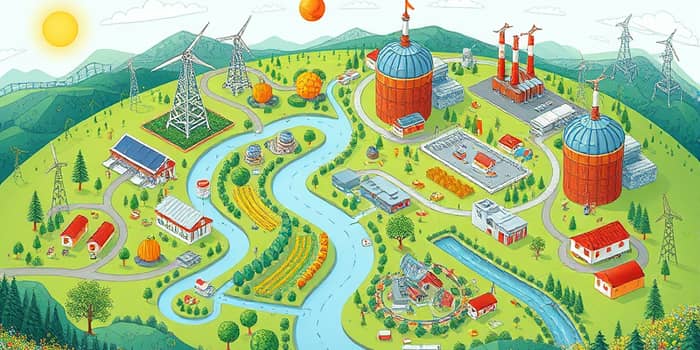
As the world confronts climate tipping points and finite resources, the circular economy emerges as a beacon of hope. Yet translating vision into reality requires not only ambition but also robust financing. This article explores how we can unlock capital, bridge funding gaps, and ignite the next wave of circular innovation.
Circular systems aim to keep products, materials, and resources in use for as long as possible, extracting maximum value before recovering and regenerating them at end of life. By maximizing product lifespan and reducing waste, these systems diminish ecological impact while fueling economic resilience.
Decoupling growth from resource consumption lies at the heart of circularity. It offers a pathway to transformative potential of circular models that can drive prosperity without further degrading the planet.
Despite soaring interest, only 2% of global investments flow into circular business models. Between 2018 and 2023, total circular investments reached $164 billion, peaking in 2021. Yet, just 4.7% of that funding supports high-impact innovations—areas like material innovation, modular design, and regenerative production.
In the European Union alone, the investment gap is estimated at EUR 29 billion per year. Current funding skews heavily toward waste management, leaving upstream innovations and design initiatives underfunded.
This breakdown highlights a heavy reliance on traditional financing channels. Venture capital, with just 7% of total circular funding despite over 1,000 deals, remains underleveraged even though early-stage funding is vital for disruptive breakthroughs.
These barriers collectively stifle momentum and limit the reach of high-potential circular innovations, perpetuating a cycle of underinvestment and slow scaling.
To bridge these gaps, stakeholders are pioneering new tools and structures:
Organizations such as Intesa Sanpaolo have allocated $23 billion since 2018 to sector-specific circular funding, demonstrating how strategic focus can amplify impact.
Regulatory frameworks play a pivotal role in shaping financing flows. Eco-design mandates, extended producer responsibility, and procurement requirements create demand signals for circular solutions.
Equally important is ecosystem collaboration. Financial institutions, corporates, startups, and government agencies must forge partnerships to align capital, expertise, and policy. Transparent monitoring systems can track capital deployment, ensuring that funds reach high-impact initiatives and that gaps are identified and closed swiftly.
As we chart the path forward, several strategic imperatives stand out:
With the global circular economy market projected to grow to $798.3 billion by 2029 (CAGR 11.4%), the stakes have never been higher. Mobilizing the required EUR 55 billion per year in the EU for infrastructure, innovation, and skills development—and even greater sums globally—demands bold collaboration and inventive financing structures.
Financing the future of circular systems is both a tremendous challenge and an unparalleled opportunity. By adopting innovative capital models, leveraging public policy, and forging cross-sector partnerships, we can transform our economic paradigm.
Now is the time for investors, policymakers, and entrepreneurs to rally behind this vision. Together, we can catalyze a wave of sustainable innovation that not only decouples growth from resource use but also builds resilient communities and a thriving planet. The future of circular systems hinges on our collective commitment to fund, scale, and sustain truly transformative solutions.
References