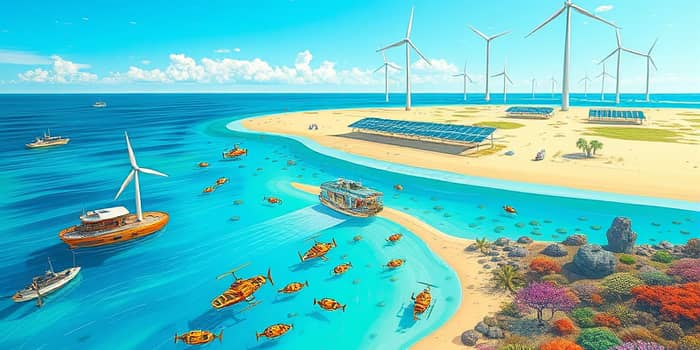
Our oceans hold boundless opportunity—economically, environmentally, and socially. Advancements in data, engineering, and policy are unlocking the next great wave of growth: the blue economy.
The global blue economy was valued at $2.3 trillion in 2025, and projections suggest it will exceed $3.6 trillion by 2032 at a CAGR of 6.6%. With ocean-related trade topping $2.2 trillion in 2023, the sea is not just a resource but a cornerstone of global prosperity.
By 2034, estimates place the market at $5.3 trillion (CAGR 6.4%), driven by marine renewables, sustainable fisheries, and emergent biotech. A healthy ocean could deliver net positive economic benefit exceeding $15 trillion, nearly 15% of global GDP.
To visualize this trajectory, consider the market projections:
Cutting-edge technologies are transforming how we explore, harness, and protect marine resources. Breakthroughs in robotics, AI, and materials science are enabling:
Marine renewable energy is surging. Offshore wind capacity in Europe jumped 1049% since the early 2000s, reaching 18.9 GW. Emerging tidal, wave, and green hydrogen technologies promise to drive net-zero pathways by 2050.
Investor interest in blue economy solutions has never been stronger. Venture capital funding in blue tech and ocean observation reached $728 million in 2025, a 53% year-over-year growth. Since 2016, over $2.3 billion has been deployed, growing sevenfold in eight years.
Core opportunity areas include:
Digital technologies alone are projected to unlock over $300 billion in value by 2030 for the ocean economy. Public-private partnerships and impact funds are scaling projects from modular floating solar to nature-based reef restoration.
Unlocking the blue economy’s potential requires addressing critical risks. Regulatory frameworks often lag behind innovation, creating governance gaps on the high seas. Harmonizing policies across jurisdictions is essential.
Environmental stewardship must guide growth. Overfishing, plastic pollution, and habitat destruction threaten marine ecosystems. Investors and operators must adopt science-based impact assessments to ensure long-term viability and community benefits.
Infrastructure modernization is urgent. Ports, shipping lanes, subsea grid connections, and observation networks need substantial upgrades to support offshore assets and real-time monitoring at scale. Coastal urbanization pressures underscore the need for resilient, climate-adaptive designs.
Building a thriving blue economy means marrying innovation with stewardship. Stakeholders must align around shared goals of resilience, equity, and profitability:
Regional hubs are emerging. Asia-Pacific leads with 33.1% market share, driven by China, India, and Australia’s offshore wind and aquaculture investments. North America holds 23.7%, with the US blue economy at $846.6 billion in 2024. Europe’s rapid wind expansion and strong policy frameworks underscore its leadership in climate-aligned ocean tech.
Corporate pioneers—from Equinor and MingYang Smart Energy in renewables, to Ocean Infinity in data services—are demonstrating that sustainable maritime ventures can deliver competitive financial returns and social impact.
As climate change accelerates, the ocean becomes both a frontier for innovation and a buffer against global warming. Blue carbon initiatives, seagrass restoration, and offshore renewables are integral to net-zero roadmaps.
Investors and innovators willing to navigate complexity, forge partnerships, and embrace long-term stewardship stand to reap transformative rewards. The blue economy is more than a market; it is a commitment to our planet’s future.
Now is the time to dive deep into ocean tech—align your capital, creativity, and conscience to unlock a sustainable blue horizon.
References