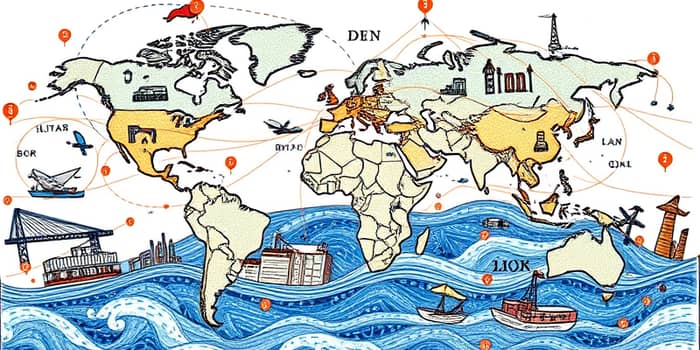
In an era of heightened uncertainty—from trade fragmentation and tariff surges to rapid technological transformation—nations and companies must cultivate endurance. Building economic resilience ensures that a setback becomes an opportunity, allowing both businesses and societies to adapt, recover, and even thrive amid disruption.
Economic resilience refers to an economy’s capacity to absorb shocks, adapt to new conditions, and rebound stronger than before. It hinges on diversified industry and workforce development, robust policy frameworks, and proactive public and private planning.
Beyond mere recovery, resilience emphasizes anticipation and preparation. By supporting resilient infrastructures to absorb shocks—from supply chain buffers to emergency fiscal measures—governments and corporations reduce vulnerability when turbulence strikes.
The latest forecasts signal a slowdown in global growth, easing from 3.3% in 2024 to approximately 2.9% in both 2025 and 2026. Advanced economies face the steepest deceleration: the U.S. GDP is expected to decline from 2.8% to around 1.6–1.8%, while the euro area may hover near 1.0–1.3%. China’s expansion will cool from 5.0% to roughly 4.3% by 2026.
Despite moderating inflation and central banks preparing rate cuts, ongoing uncertainty in policy frameworks and fragmented trade patterns could prolong hesitation in corporate investment and hiring decisions.
Governments are recalibrating trade, tax, and migration policies, introducing volatility that demands rapid adaptation.
These policy shifts can shave up to 0.5 percentage points off GDP growth, underscoring the need for targeted government spending and monetary easing to cushion transitional strains.
Leading firms have demonstrated remarkable agility in reconfiguring operations and supply chains post-pandemic.
Such strategies not only neutralize immediate shocks but also serve as blueprints for longer-term structural agility in uncertain markets.
Financial markets have displayed resilience: asset prices remain elevated, and private market EBITDA stands solid with comfortable interest coverage ratios.
Yet sectoral performance diverges. Tech, artificial intelligence (AI), and renewable energy are emerging as growth engines, while trade-sensitive industries like automotive and apparel face tighter margins.
AI investment ranks among the top priorities for corporate leaders. By harnessing medium-term productivity gains from AI, businesses can offset slower top-line growth and redirect resources toward innovation and digital transformation.
Building durable resilience requires coordinated action across public and private sectors. Key recommendations include:
These measures, when combined with inclusive growth and social safety nets, form the backbone of a truly resilient economic model capable of weathering future storms.
Economic shifts—whether from policy realignments, trade disruptions, or technological breakthroughs—will continue to test the adaptability of nations and enterprises alike. By embedding resilience into every strategy, organizations can transform adversity into a catalyst for sustained growth.
Ultimately, adaptation is the linchpin of long-term success. Those who proactively recalibrate supply chains, invest in digital transformation, and support broad-based skill development will emerge stronger, turning today’s shifts into tomorrow’s returns.
References