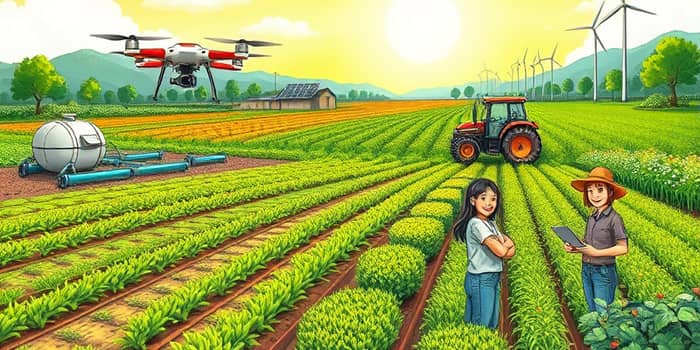
As the global population grows and climate volatility intensifies, ensuring that every community has reliable access to nutritious food has become an urgent priority. Technological breakthroughs in agriculture offer a path to greater resilience, efficiency, and sustainability. This article explores the transformative innovations that can reshape farming, strengthen food systems, and help achieve a world free from hunger.
In 2024, more than 295 million people faced acute hunger, and nearly 2.3 billion were moderately or severely food insecure. Yet projections for 2025 indicate a hopeful turn: global food insecurity could drop by over 26 percent, benefiting 220 million fewer people.
However, stark regional disparities threaten progress across continents. Sub-Saharan Africa remains the hardest hit, with 26.9 percent of its population food insecure, while Asia could see a decline from 15.4 percent to 8.1 percent next year. Escalating costs of fertilizer, energy, and transport continue to strain farmers’ budgets even as per capita incomes rise in many countries.
By 2025, precision agriculture has become mainstream, enabling farmers to optimize water, fertilizer, and pesticide use through advanced analytics. Artificial intelligence and machine learning process vast data streams from soil sensors, weather forecasts, and crop imagery to deliver real-time guidance.
These systems empower farmers to make precision-informed choices that cut input costs and increase productivity, driving both profitability and environmental stewardship.
Drones equipped with high-resolution cameras and sensors now scan fields for early signs of disease, insect outbreaks, and water stress. Combined with satellite imagery and ground-based sensors, drone data feed into AI platforms that pinpoint problem areas with unprecedented accuracy.
Automation innovations not only improve yield consistency but also address farm labor shortages effectively, especially in large-scale operations where manual labor costs can be prohibitive.
Water scarcity looms large in many agricultural regions. Modern irrigation technologies harness Internet of Things (IoT) sensors and renewable energy to conserve every drop:
• Drip irrigation delivers water directly to the root zone, slashing waste. Smart systems link soil moisture probes with weather forecasts, triggering irrigation only when necessary. Rainwater harvesting and solar-powered pumps further reduce reliance on costly grid power and depleting freshwater reserves.
By maximizing resource efficiency and yields, these solutions protect crops against drought while preserving watershed health for future generations.
Consumers increasingly demand proof that their food is sustainably produced. Blockchain technology offers immutable, end-to-end traceability—recording each step from field to fork. Farm management platforms integrated with blockchain verify adherence to sustainability standards and enhance trust.
Producers can demonstrate organic certification, fair labor practices, and reduced emissions, meeting retailer requirements and commanding premium prices. At the same time, real-time visibility across supply chains helps stakeholders respond swiftly to quality issues or recalls.
Advances in genetics have given rise to crops engineered for drought tolerance, pest resistance, and nutrient efficiency. These varieties reduce the need for chemical inputs, bolster yield stability under stress, and conserve soil health.
On-farm renewable energy—solar arrays, wind turbines, and biogas digesters—power irrigation pumps, greenhouses, and processing units with minimal greenhouse gas emissions. Coupling energy generation with water and nutrient management systems creates off-grid solutions ideal for remote and vulnerable communities.
Agroforestry blends trees, crops, and livestock into synergistic landscapes that enhance biodiversity, sequester carbon, and stabilize soils. For individual farmers, shifting to sustainable practices can begin with:
These methods foster long-term productivity gains and reinforce ecosystem services vital for healthy farms.
The precision fertilizer market in the Asia-Pacific region is projected to grow at 16 percent annually through 2025, reflecting broad adoption of smart nutrient management. Simultaneously, international partnerships are scaling impact across continents.
Real-world applications illustrate the power of these technologies. In Mali, rice farmers using AI-driven recommendations achieved 0.9 tons per hectare higher yields and an extra US$320 per hectare in income. In Honduras, a World Bank program empowered over 6,000 producers—33 percent women and 15 percent youth—generating nearly 6,700 new jobs in coffee, dairy, and honey value chains.
Yet conflict-driven hunger surges in regions like Gaza and Sudan, while extreme weather events threaten harvests worldwide. Trade barriers and policy inconsistencies can hamper technology adoption and market access.
Overcoming these obstacles demands coordinated efforts: investing in resilient infrastructure, fostering equitable trade policies, and prioritizing peacebuilding to secure livelihoods.
The United Nations’ Sustainable Development Goal 2 calls for doubling smallholder productivity and incomes by 2030, and implementing resilient agricultural practices. To meet these targets, stakeholders must unite:
• Governments should create enabling policies and invest in rural broadband and research. • Private sector actors can scale breakthrough solutions and facilitate financing for smallholders. • NGOs and farmer cooperatives must drive training and knowledge-sharing on new technologies.
By championing innovation, fostering partnerships, and empowering farmers, we can build a food system that nourishes every community, restores ecosystems, and endures for generations to come.
References