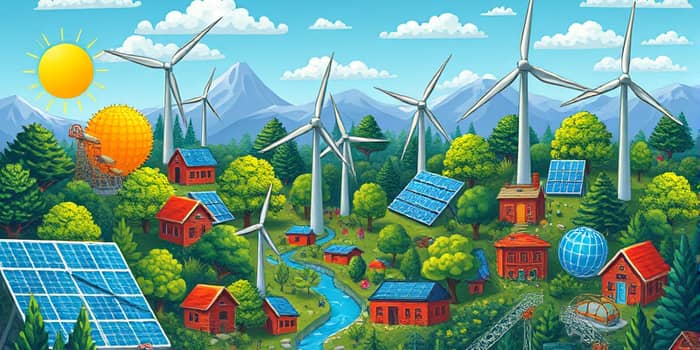
Across boardrooms and research labs, there is growing recognition that harnessing technology for environmental stewardship is no longer optional—it is imperative. From multibillion-dollar investment forecasts to groundbreaking prototypes, the climate tech ecosystem is unfolding at unprecedented speed. Stakeholders worldwide are aligning around a shared vision: to decouple economic growth from emissions and deliver sustainable prosperity for all.
The journey ahead demands bold ambition and unwavering collaboration. Governments, corporations, investors, and entrepreneurs must converge with urgency. By channeling capital, policy support, and human ingenuity toward climate solutions, we can forge a resilient future and unlock new value streams that benefit people and planet.
The global climate tech market is in the midst of a rapid expansion phase. Analysts project growth from $26.12 billion in 2024 to $32.49 billion in 2025 at an annual CAGR of about 24.4–24.94%. By 2029, market size could surge to $79.45 billion and reach $235.05 billion by 2034, fueled by demand for clean energy and low-carbon innovations. expected to skyrocket to $79.45B underscores the scale of opportunity for investors and solution providers alike.
North America commands roughly 36.73% of the global share in 2024, reflecting robust venture capital activity and supportive regulatory frameworks. Climate tech funds have posted an internal rate of return 9% higher than overall VC portfolios from 2020 to 2024. Q3 2025 saw $11.1 billion in equity funding, a slight dip from Q2’s $11.5 billion but still a testament to sustained investor confidence.
At COP29, world leaders called for tripling annual climate finance from $100 billion to $300 billion by 2035, with a goal to mobilize $1.3 trillion per year for developing economies. Such commitments signal a turning point in scaling infrastructure and innovation where it is needed most.
The pace of technological breakthroughs across sectors is inspiring. Artificial intelligence and machine learning are now integral to climate modeling, weather forecasting, and emission monitoring. Renewable energy—spanning advanced photovoltaics, offshore wind farms, and next-generation energy storage—is achieving new cost milestones. Carbon capture, utilization, and storage (CCUS) platforms are maturing, while precision agriculture and resilient crop varieties promise to bolster food security under shifting weather patterns. data-driven precision for carbon accounting has emerged as a foundational capability that transforms raw data into actionable insights.
Despite the bright horizon, access to capital remains a critical constraint. Approximately 57% of climate tech startups will need to raise funding within the next 12 months to maintain growth, even as many have reduced cash burn. capital selectivity challenges accelerate impact captures the paradox: investors prefer larger, later-stage deals, leaving early innovators underfunded.
Key market drivers are diverse and interlocking:
As of 2024, global temperatures hit 1.3°C above the 1951–1980 baseline, and fossil CO₂ emissions rose to 37.4 billion tonnes. In this context, policy becomes the backbone of systemic change. Nationally determined contributions, stricter emissions standards, and clean energy incentives are accelerating deployment. China’s share of Asia Pacific clean tech investment reached 76% in 2024, driven by large-scale solar and battery manufacturing.
However, the climate crisis is also a challenge of equity. Developing nations require around $1.3 trillion annually by 2035 to build resilient infrastructure and foster local innovation. COP29’s finance targets are a rallying cry for donors and multilateral institutions to close this funding gap, ensuring that emerging economies can leapfrog to green growth pathways.
While certain sectors—such as robotics, EVs, and digital connectivity—have surged ahead, green innovation still lags. The transition to a low-carbon economy requires not only new technologies but also systemic shifts in supply chains, consumer behavior, and financing models. Policymakers and investors must bridge the chasm between novel prototypes and scalable, cost-competitive solutions.
Building local capacity, reducing deployment hurdles, and standardizing measurement protocols are vital to mainstreaming climate tech. This means forging public-private partnerships that marry regulatory certainty with market incentives, and fostering an ecosystem where entrepreneurs can iterate and scale rapidly.
Startups are injecting creativity and speed into the climate arena. From modular solar technologies that reduce installation time to blockchain platforms enhancing carbon credit transparency, these ventures are reshaping traditional industries. Their agility allows them to pilot solutions in real-world settings and pivot based on performance data.
Innovations like falling battery costs democratize access to clean power, while digital marketplaces connect farmers to precision-agriculture tools, boosting yields and conserving water. By driving down costs and broadening adoption, startups are the pivotal agents transforming ambition into action.
“What you cannot measure, you cannot improve.” This adage rings especially true for climate action. Carbon data platforms, satellite analytics, and IoT-based monitoring systems are empowering stakeholders to track emissions, verify progress, and optimize interventions. carbon data platforms are foundational for transparent reporting and accountability, underpinning both policy design and investment decisions.
Looking forward, the climate tech market could swell to $149.27 billion by 2032 and $235.05 billion by 2034, maintaining a near-25% CAGR. Yet, these figures represent more than financial opportunity—they embody a collective commitment to a healthier planet. Realizing this potential hinges on aligning policy frameworks, democratizing finance, and fostering an inclusive innovation ecosystem.
Investors, governments, entrepreneurs, and consumers all have a role to play. By collaborating across sectors and geographies, we can accelerate the deployment of solutions that decouple growth from emissions, enhance resilience, and uplift communities worldwide. The moment to act is now—together, we can leverage technology to safeguard Earth’s future for generations to come.
References