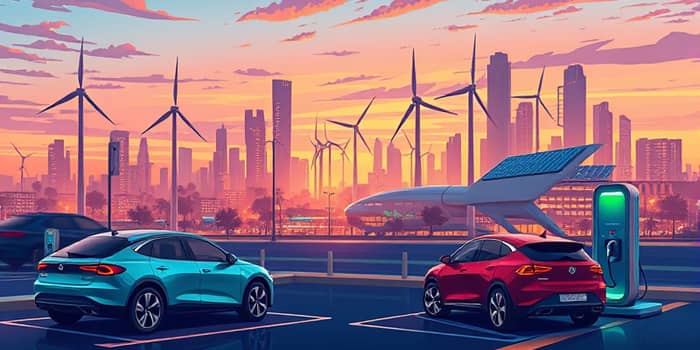
The electric vehicle market is more than a trend—it is reshaping transportation and investment landscapes worldwide, offering transformational growth across sectors and exciting new avenues for investors.
Electric vehicle sales are skyrocketing. In 2024, global EV deliveries reached 17.8 million units, representing roughly 21% of new car sales. By 2025, sales are projected to climb to 21.3 million units, capturing a 24% market share of global new car purchases.
Looking further ahead, analysts forecast that annual EV sales will exceed 40.1 million units by 2030, driven by both consumer enthusiasm and regulatory pressure. In China, over half of all new vehicles sold are electric, making it the planet’s largest and fastest-growing EV market. In North America, battery electric vehicles made up 7.4% of new car sales in Q2 2025, totaling about 310,839 vehicles, as traditional automakers and startups alike ramp up production.
As EV adoption accelerates, charging infrastructure is emerging as a critical investment frontier. Globally, the EV charging market was valued at $31.7 billion in 2024 and is anticipated to swell to between $125.4 billion (by 2030) and $199.8 billion (by 2033).
Regional dynamics vary but share a similar upward trajectory:
The competitive landscape is broad and evolving, with legacy manufacturers, startups, infrastructure companies, and utilities forging alliances:
Tesla continues to dominate the US EV market with a 46% share, while General Motors has doubled its EV deliveries year-over-year. Traditional automakers such as Volkswagen, Hyundai, and Honda are making aggressive moves to expand EV lineups.
Charging leaders include ChargePoint, Electrify America, EVgo, ABB, and Vattenfall, all pursuing expansive public and private collaborations to deploy networks across cities, highways, and commercial facilities.
To capitalize on the EV revolution, investors should consider diversifying portfolios across vehicles, charging infrastructure, battery technology, and service platforms. Evaluate opportunities in both mature markets and high-growth regions such as Southeast Asia.
Partnerships with technology providers or utilities can unlock access to novel business models like Energy-as-a-Service or bundled home charging solutions. Early-stage funding in battery innovation or grid-smart charging platforms can deliver outsized returns as the sector matures.
Beyond pure financial returns, investing in electrification drives significant environmental and social benefits. Widespread EV adoption promises lower urban emissions, improved air quality, and reduced dependence on fossil fuels.
Emerging trends include second-life battery applications for energy storage, recycling initiatives that recover critical materials, and smart grid integration and recycling efforts that ensure circularity. These developments underscore the long-term potential of the sector.
As the EV ecosystem accelerates, stakeholders must remain agile, monitor policy shifts, and embrace technological breakthroughs. Investors who align with sustainability goals and emerging consumer behaviors will be poised to reap the rewards of this transformative era.
In the journey toward a zero-emission future, the EV revolution is not just about charging vehicles—it’s about fueling innovation, economic growth, and a cleaner planet. Seize the opportunity and drive forward into the electrified horizon.
References