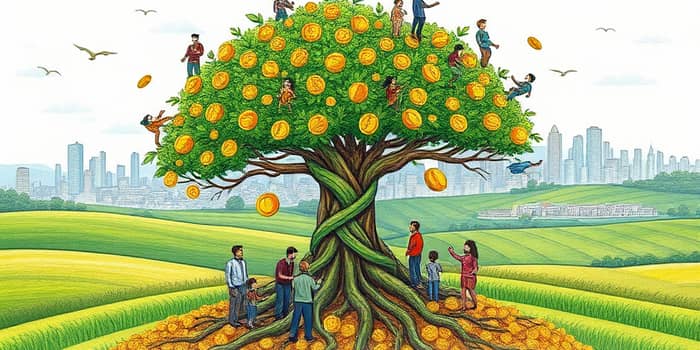
The world stands at a pivotal moment when the flow of capital and the goals of environmental stewardship converge. As investors, corporations, and policymakers recognize that financial success cannot be decoupled from planetary health, new paradigms are emerging to reshape markets and societies.
Driving this transformation is an unprecedented expansion of sustainable finance, reflecting a collective commitment to balance growth with impact. Against a backdrop of rapid climate change and social inequities, the finance sector is evolving to embed purpose at its core, championing both profit and the greater good.
In 2024, the sustainable finance market size reached a remarkable $5.87 trillion, and projections indicate a compound annual growth rate of 19.8% through 2034. By the early 2030s, the industry is expected to surpass $20 trillion, underscoring the accelerating demand for responsible investment products.
Debt markets have mirrored this surge: sustainable debt issuance topped $1 trillion in 2024 for the fifth consecutive year. While sustainable loans raised $390 billion in the first half of 2025 reflect an 18% year-over-year dip, signs of recovery in the second quarter highlight enduring investor confidence.
These opportunities are not merely numeric. Each investment in nature-positive transitions plants the seeds for new industries, green jobs, and community resilience. The World Economic Forum estimates up to $10 trillion in business value and 400 million jobs by 2030 through nature-based solutions.
Sustainability has evolved from niche preference to mainstream requirement. Institutional investors increasingly view environmental and social criteria as integral to risk management, demanding rigorous reporting and verified outcomes. This shift is driving issuers to refine frameworks, align with SDGs, and seek third-party assurance for greater credibility.
Regulators worldwide are tightening frameworks to ensure capital flows support genuine sustainability outcomes. Europe’s 2025 testing year will impose more stringent rules on eligibility and disclosure, while UK mandates demand minimum sustainable allocations for funds.
Meanwhile, anti-greenwashing initiatives are gaining momentum: the EU’s fund labeling regime and Canada’s Bill C-59 aim to protect investors and preserve market integrity. At COP29, multilateral development banks pledged to raise climate finance to $120 billion by 2030 and $300 billion by 2035, reinforcing global cooperation.
These shifts reinforce the imperative for clear, consistent standards. Data-powered ESG analytics enhance transparency, helping stakeholders verify claims, measure progress, and manage risk in real time.
In Asia-Pacific, regulators are crafting bespoke guidelines, with China advancing green bond standards and Japan launching stewardship codes to elevate ESG disclosures. These tailored approaches reflect the region’s urgency to address climate vulnerabilities and harness green finance for economic resilience.
The quest for sustainable impact has spurred a wave of financial innovation. Blended finance vehicles—combining public and private capital, first-loss guarantees, and risk mitigation—are channeling billions into emerging markets, unlocking opportunities that conventional finance might overlook.
Other groundbreaking models include:
These instruments demonstrate how creative structuring can reduce barriers, attract diverse investors, and scale solutions across sectors—from hard-to-abate industries to cutting-edge agtech and regenerative agriculture.
Beyond numbers and regulations lies the human dimension of sustainable finance. Ethical considerations and ethical dimensions and ecological accounting are reshaping corporate strategies and redefining fiduciary duty. Investors now weigh not only financial returns but also the health of communities and ecosystems.
Financial inclusion and social equity have gained prominence, with goals spanning affordable clean energy, gender equality, and poverty reduction. Sustainable Development Goals provide a unifying compass, guiding both capital allocation and corporate priorities.
Digital transformation and AI are pivotal in this journey. From asset tracking with blockchain solutions to advanced climate risk analytics, technology empowers stakeholders with timely insights, bolstering accountability and accelerated action across portfolios.
However, challenges remain. Fund launches have slowed, consolidation is rising, and political headwinds can undermine incentives. Bridging the gap between aspiration and implementation requires persistent collaboration among investors, businesses, and public entities.
Global momentum masks regional nuances. In Europe, harmonized taxonomies and robust ESG mandates foster innovation and investor trust. North America balances federal and state incentives, with climate-focused credit markets gaining steam. In emerging markets, blended finance drives climate adaptation and social infrastructure, overcoming capital constraints.
These regional approaches illustrate diverse pathways to integrate ecological and social values within distinct regulatory and cultural landscapes, offering lessons and opportunities for cross-border collaboration.
Despite ambitious targets, gaps persist between commitments and concrete outcomes. Greenwashing threats loom large, eroding trust and slowing progress. To overcome these barriers, stakeholders must champion transparency, robust metrics, and stakeholder engagement at every stage.
Partnerships between multilateral institutions, local governments, and private investors can close financing shortfalls. By aligning incentives, sharing risks, and leveraging technology, these alliances can accelerate infrastructure development, clean energy deployment, and social programs that uplift vulnerable populations.
Ultimately, the path forward demands integrity, innovation, and unwavering resolve. By embracing a holistic vision—one that sees finance as a tool for regeneration and inclusion—we can transform markets, restore ecosystems, and elevate human well-being.
The integration of ecological and social values into finance is more than a trend; it is an imperative. As capital continues to flow toward purpose-driven opportunities, each decision carries the potential to nurture the planet and empower communities. Together, we stand ready to write the next chapter of resilient, equitable growth—one investment at a time.
References