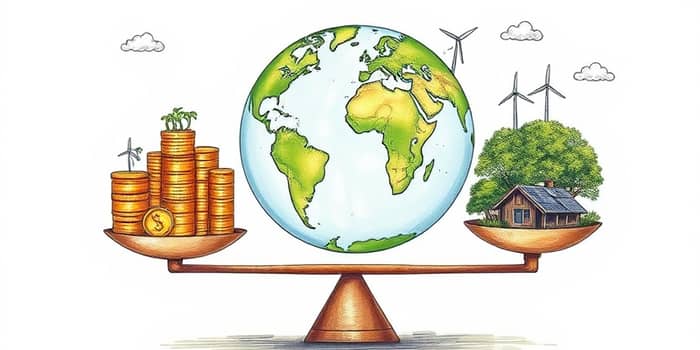
The dawn of a new industrial era is shadowed by the mounting toll of environmental degradation. Societies around the world are grappling with the paradox of progress: how to fuel prosperity without sacrificing the very ecosystems that sustain us. Economists, policymakers, and researchers are converging on innovative ways to integrate climate impact into financial planning, offering pathways that align survival with growth.
At this critical juncture, decision makers must ask: what is the true cost of advancing our economies while navigating a warming planet? By deploying rigorous modeling techniques and examining real-world data, it becomes possible to chart a course that safeguards livelihoods and ecosystems. The following exploration delves into the core frameworks, metrics, and policy instruments that define the frontier of climate economics, illuminating the trade-offs embedded in every ton of carbon and every dollar mobilized for resilience.
Climate change is not a distant specter but a force already reshaping markets and national budgets. Recent studies project a income reduction of 19% within 26 years even if emissions are curtailed, reflecting irreversible shifts in productivity and resource availability. Meanwhile, the US Interagency Working Group places the social cost of carbon at US$37 per tonne of CO₂, quantifying the hidden price tag of emissions in terms of health impacts, infrastructure losses, and ecosystem damage.
These figures underscore an urgent truth: every ton of CO₂ released today incurs long-lasting burdens for future generations. Understanding these stakes empowers stakeholders to weigh mitigation expenses against avoided damages, fostering policies that can steer the global economy toward a sustainable trajectory.
To navigate the complexity of climate-economy interactions, researchers employ a suite of modeling approaches. Each framework offers distinct insights, capturing trade-offs, feedback loops, and sectoral interdependencies.
Model selection hinges on criteria such as parsimony, tractability, empirical consistency, and the capacity to handle non-linear feedbacks. A hybrid suite often delivers the richest insights, bridging global forecasts with local realities.
Concrete examples bring these models to life, translating theory into tangible outcomes. Nature-based solutions alone could generate an astonishing nature-based solutions could create around 395 million jobs worldwide by 2030, particularly in ecosystem restoration, sustainable agriculture, and forest management. At the same time, investments in adaptation are poised to soar from US$2 trillion today to US$9 trillion by 2050, a transformation reflecting an escalating need for resilient infrastructure.
Despite these surging flows, global climate finance remains dwarfed by funds backing carbon-intensive activities. Developing nations, bearing disproportionate adaptation costs relative to GDP, call for novel mechanisms: debt-for-nature swaps, dedicated loss-and-damage funds, and equitable technology transfers.
Designing effective policy mixes requires blending regulation with market incentives. Around the globe, carbon pricing mechanisms range from cap-and-trade schemes to levy-based taxes. Meanwhile, feed-in tariffs, clean energy mandates, and innovation subsidies accelerate the deployment of renewables and low-carbon technologies.
Successful climate strategies often rest on sequenced policy instruments and market mechanisms, where early R&D support lowers technology costs, paving the way for broad carbon pricing or tradeable credits.
No single model can capture every dimension of climate risk. There is deep uncertainty about future technologies, shifting comparative advantages, and potential tipping points in natural systems. Rich nations frequently leverage advanced tools and funding, while low-income regions struggle with limited data and resources.
Equity concerns loom large: climate policies that neglect distributional impacts can widen existing inequalities. Ensuring just transitions demands targeted support for vulnerable communities, inclusive governance structures, and robust international collaboration on finance and technology transfer.
Future research must bridge disciplinary boundaries, linking macroeconomic projections with granular sectoral and regional analyses. Advancements in computational power and data availability promise models that can dynamically incorporate migration flows, trade adjustments, and innovation feedback loops.
By continuously refining these tools and grounding them in real-world outcomes, policymakers can design adaptive strategies that respond to emerging risks and opportunities. This iterative process will be essential for steering global development toward a path where economic growth and planetary health reinforce each other.
Ultimately, the price of progress need not be paid in lost ecosystems or stunted human potential. Through collaborative action, rigorous modeling, and bold policy innovation, society can harness co-benefits like health improvements and resilience, crafting a future where prosperity and sustainability move forward hand in hand.
References