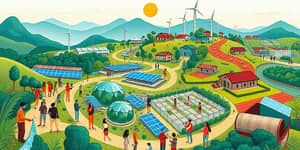
The quest for prosperity often pits economic growth against ecological health, but a regenerative blueprint charts a new course. By shifting paradigms from extraction to renewal, this model offers a pathway to nurture ecosystems, empower communities, and ignite innovation. In this detailed guide, we explore definitions, frameworks, business strategies, and policy actions that underpin a truly transformative economic system. Join us as we unveil actionable steps and inspirational stories that can reshape our collective future.
A regenerative economy goes beyond mere conservation, emphasizing restoration and renewal at every stage of production and consumption. It actively regenerate and revitalize resources by designing systems that mimic natural cycles. Unlike a linear economy that follows a produce-use-discard pattern, regenerative models aim for positive contributions for nature and society, creating net gains in biodiversity, soil health, and social well-being.
At its core, this approach values long-term resilience over short-term profit, maximizes value of resources while minimizing waste, and integrates living systems principles into decision-making. Companies, governments, and communities can adopt this mindset to foster innovation that heals rather than depletes.
True regeneration rests on a balanced foundation of environmental, social, and economic pillars. Each dimension supports and reinforces the others, ensuring that progress in one area does not undermine gains in another. The three pillars can be summarized as:
By operationalizing these pillars, stakeholders can build systems that deliver prosperity without overshooting ecological boundaries or neglecting social justice.
Several frameworks provide structures for implementing regenerative practices. The THRIVE Framework maps social floors against environmental ceilings to highlight safe and just operating spaces. The five principles of a green economy emphasize people-centered growth, sustainable investment, and long-term perspectives. Blue Print for Regenerative Living from One Community Global offers open-source solutions for housing, food, energy, and social architecture. Meanwhile, the Brain and Natural Capital Blueprint underscores the interdependence of cognitive and ecological resilience.
Together, these models guide practitioners in aligning strategy with ecological science and social equity objectives, forming a cohesive blueprint for systemic change.
Leading organizations are pioneering new ways to deliver products and services that fuel regeneration. Circular business models such as leasing, shared ownership, and take-back programs extend product lifespans and reduce waste. Companies redesign goods with modular components for easy repair and end-of-life disassembly.
By transforming the way value is created and captured, businesses can unlock new revenue streams while supporting ecological and social resilience.
Robust policy interventions are essential to accelerate the shift toward regenerative economies. Innovative measures include the United Kingdom’s plastic packaging tax, South Korea’s 95% waste recycling mandate, and the European Green Deal’s ambitious circular economy action plan. Governments can further catalyze progress by setting clear targets, offering incentives for recycled material use, and enforcing extended producer responsibility schemes.
Effective regulation aligns economic incentives with environmental and social outcomes, embedding the polluter pays principle and ensuring that true costs are reflected in market prices. Inclusive governance structures can safeguard against elite capture and ensure that benefits flow to all stakeholders.
Transitioning to regenerative and circular models unlocks vast economic opportunities. By 2030, the global economy could realize up to $26 trillion in additional value and create 65 million new jobs. Investments in clean energy, regenerative agriculture, and sustainable infrastructure deliver 6.5% higher GDP growth in proactive countries compared to those relying on extractive practices.
Beyond gross metrics, these investments foster greater income equality, strengthen local economies, and cultivate innovation ecosystems that benefit marginalized communities. The ripple effects of job creation and improved public health contribute to a virtuous cycle of shared prosperity.
Building a workforce equipped for the regenerative era requires targeted skills development. Green and digital training programs empower youth, women, and marginalized groups with the tools needed to thrive in emerging industries. Emphasis on cognitive capacity building and lifelong learning ensures adaptability in a rapidly evolving job market.
By integrating sustainability principles into education and vocational training, societies can cultivate a pipeline of talent ready to design and operate systems that maintain environmental integrity and social equity.
Successful adoption of regenerative practices combines behavioral insights with economic incentives. Organizations should embed sustainability into their core vision, set measurable key performance indicators, and reward innovation that aligns with ecological and social objectives. Engaging suppliers, customers, and community partners creates a shared sense of purpose and accountability.
Resource efficiency measures—such as closed-loop production systems and precision resource tracking—help maintain material value over multiple life cycles, reducing scarcity risks and operational costs. Integrating digital tools like IoT sensors and blockchain can enhance transparency and optimize resource flows.
Regeneration takes root in local communities but flourishes through global collaboration. Territorial cohesion policies can bridge urban and rural divides, fostering decentralized solutions that leverage local strengths. Innovation hubs and community-based incubators support entrepreneurs in co-creating context-specific regenerative projects.
Cross-border networks for knowledge sharing, capacity building, and financing amplify impact and accelerate the diffusion of best practices, ensuring that no region is left behind in the journey toward resilience.
Mobilizing capital for regeneration requires creative financing approaches. Blended finance structures combine public, private, and philanthropic funds to de-risk early-stage projects. Carbon markets and green bonds channel investments into low-carbon infrastructure and nature-based solutions. Proposed mechanisms, such as a global brain-nature capital fund, aim to bolster cognitive and ecological resilience in vulnerable regions.
Aligning subsidies and tax incentives with long-term societal costs ensures that economic actors are rewarded for delivering positive environmental and social outcomes. This realignment of financial flows is crucial to scaling regenerative innovations at pace and scale.
The regenerative blueprint is more than an abstract ideal—it is a practical roadmap for redesigning economic systems to serve people and planet. By embracing restorative practices, innovative business models, and forward-looking policies, we can create a future where prosperity and ecological health reinforce each other. The time to act is now: let us commit to this transformative journey and usher in a new era of resilient, regenerative prosperity.
References