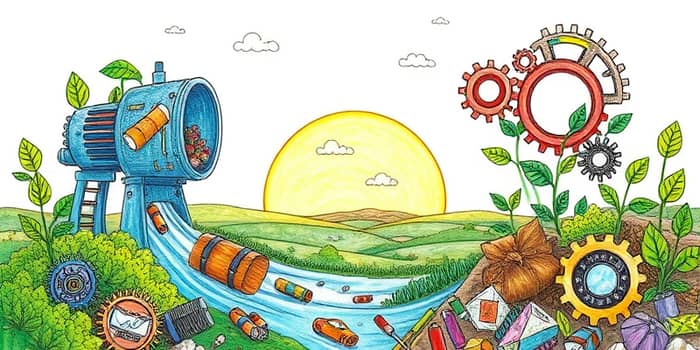
In a world grappling with overflowing landfills and depleting natural resources, the Waste-to-Value paradigm offers a transformative pathway. By reimagining waste as a raw material, industries and communities can unlock new revenue streams and significantly reduce their environmental footprint. This approach not only addresses urgent ecological concerns but also catalyzes innovation across the supply chain.
When businesses adopt this mindset, they shift the narrative from burden to asset, turning by-products into opportunities. This shift aligns with rising consumer demand for sustainable practices and appetites for brands that demonstrate authentic environmental stewardship. Embracing Waste-to-Value is more than an operational choice—it’s a strategic imperative for long-term resilience.
The global waste management market is projected to reach $1.28–$1.5 trillion by 2025, expanding to an estimated $2.3–$2.36 trillion by 2033. This growth is fueled by stringent regulations, technological breakthroughs, and the escalating costs of virgin material extraction. In the United States, waste collection services alone are valued at $86.1 billion in 2025, reflecting the significant economic footprint of resource recovery industries.
Beyond these figures, the broader circular economy represents an estimated $4.5 trillion economic potential globally. Companies that integrate resource recovery can tap into this expansive market, reduce dependency on volatile commodity prices, and fortify supply chains against future disruptions.
Traditional linear models treat waste as an unavoidable byproduct, while circular frameworks embed resource recovery into product lifecycles. Companies are pioneering a variety of Waste-to-Value business approaches that convert end-of-life materials into fresh revenue streams:
In addition to new sales channels, organizations can leverage several economic levers to maximize profits:
Effective Waste-to-Value initiatives often center on three pillars: reducing waste at the source, recycling materials into usable inputs, and repurposing surplus into innovative products. Each step reinforces the others, creating a robust loop of resource efficiency.
Reduce: Companies begin by analyzing production processes to identify waste hotspots. For example, the healthcare sector’s switch to alternative polymers eliminated 85,000 tonnes of landfill waste and cut 235,000 tonnes of CO₂ emissions annually, demonstrating the power of source-level interventions.
Recycle: Advanced sorting systems, bolstered by AI and machine learning, enable plants to recover a higher percentage of plastics, metals, and paper. These reclaimed materials are then melted, purified, and reintroduced into manufacturing lines, reducing reliance on virgin feedstocks.
Repurpose: Upcycling and creative design breathe new life into materials once destined for disposal. From premium furniture crafted from ocean-bound plastic to biogas generated from organic food scraps, repurposing transforms low-value waste into high-margin offerings.
Rapid innovations are making Waste-to-Value more accessible and scalable. Leading-edge technologies include:
Decentralized processing hubs also streamline operations by locating recycling facilities closer to waste sources. This model reduces transportation costs and supports localized economic development through smart city initiatives.
Governments worldwide are strengthening policies to catalyze circularity. Extended Producer Responsibility (EPR) schemes mandate manufacturers to manage post-consumer waste, shifting disposal costs back to the producer. Stricter recycling targets and landfill bans are accelerating investment in automated sorting and value recovery plants.
Incentive programs, such as tax deductions for recycled content and grants for green technology adoption, further enhance the business case. Companies that proactively align with these policies can secure first-mover advantages and foster long-term partnerships with regulators.
E-waste represents one of the fastest-growing waste streams, expected to reach 54–74 million metric tons annually by 2030. Firms specializing in urban mining have developed scalable solutions for metal recovery, tapping into the soaring demand for copper and lithium in electric vehicles and data centers.
In the plastics sector, industry leaders are partnering with startups to collect ocean-bound debris and transform it into branded consumer goods. This synergy not only cleans marine ecosystems but also delivers compelling marketing narratives for sustainability-focused brands.
Organic waste is equally ripe for innovation. Municipalities and agribusinesses are deploying anaerobic digesters that convert food scraps and agricultural residues into renewable natural gas. By monetizing both energy production and waste diversion credits, these ventures achieve attractive internal rates of return.
Advanced data ecosystems for end-to-end optimization will integrate AI, IoT, and analytics to monitor every stage of resource recovery. Smart city frameworks will leverage these insights to balance material flows dynamically.
We anticipate continued consolidation through mergers and strategic partnerships, enabling smaller operators to access capital and technology. At the same time, regulatory landscapes will evolve, introducing new compliance requirements that reward transparent supply chains.
Despite the momentum, challenges remain. Consumer education is essential to drive participation in recycling programs, while legacy infrastructures require significant upgrades to support decentralized processing. Moreover, ensuring equitable technology access for small and medium enterprises will be critical to broad-based adoption.
The Waste-to-Value revolution is not a distant ideal but a present-day reality. Companies that embrace resource recovery stand to benefit from resilient supply chains and strengthened brand reputation, contribute to a healthier planet, and secure a competitive edge.
As we look toward a future defined by circularity, one truth remains clear: the most valuable asset in any organization may well be the waste it generates. Harness this potential today, and transform liabilities into enduring sources of prosperity.
References