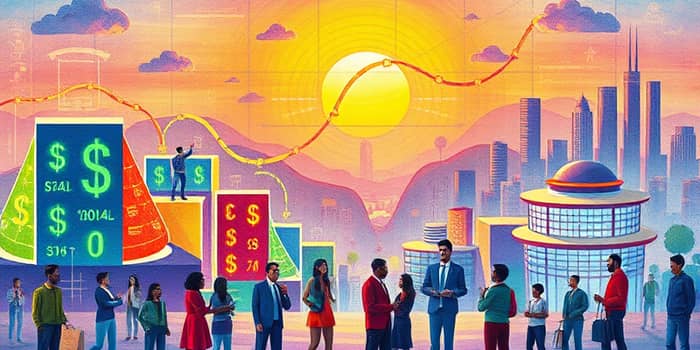
In an age of rapid transformation, finance transcends its traditional role of capital allocation. Financial foresight is the disciplined practice of scanning emerging trends, building scenarios, and planning for plausible futures. This proactive stance empowers institutions, policymakers, and individuals to anticipate and prepare for change before challenges escalate into crises.
We live in a complex world defined by accelerated technology, global interconnection, and simultaneous crises. This condition—often called a polycrisis and cascading shocks environment—renders linear planning insufficient. Organizations must cultivate a dedicated foresight discipline, akin to strategy or risk management, to navigate uncertainty and seize opportunities.
According to the OECD, strategic foresight is not about predicting one fixed outcome but about exploring multiple and non-linear consequences across a spectrum of plausible futures. By systematically anticipating these shifts, institutions can design resilient strategies and inform better policymaking.
Anticipatory thinking, as described by futurist Daniel Burrus, differentiates between certainty-based “hard trends” and probability-based “soft trends.” Recognizing this distinction helps organizations focus on inevitable changes while remaining agile around uncertainties.
Beyond managing assets, finance can serve as an early-warning system for society. Market signals, lending patterns, and shifts in saving behavior reveal deeper social transformations. For instance, rising debt levels among gig workers signal the need for flexible credit products, while demographic shifts highlight retirement security gaps.
Research by CASSS and ASAE identified 41 drivers of change—ranging from aging populations to hybrid work models—that demand financial institutions sharpen their foresight capabilities. Similarly, a recent AARP survey noted increased optimism among U.S. adults in early 2025, yet persistent debt and limited savings, especially among women, underscore uneven financial well-being.
Financial foresight enables stakeholders to spot emerging needs—often hidden until they become urgent. Proactive scanning can address issues such as:
By anticipating these dynamics, financial actors can design products and services that align with evolving social realities. This approach prevents downstream crises and fosters greater resilience across communities.
Identifying future scenarios is only half the battle. Translating insights into tangible solutions calls for disciplined methods such as scenario planning and backcasting from a desired future. Institutions can work backwards from an envisioned outcome—say, universal digital inclusion—to map the policy changes, technological investments, and partnerships needed today.
Leading banks and fintechs are already leveraging AI, IoT, and embedded finance to prototype resilient customer journeys. By stress-testing new offerings against multiple futures, organizations can avoid costly missteps and ensure solutions remain relevant in shifting environments.
While technology is a powerful enabler, people remain central to every system. Effective foresight uncovers hidden biases, blind spots, and barriers to inclusion. Engaging customers, employees, and communities in co-creative workshops ensures that emerging products address genuine needs rather than assumed problems.
BCG emphasizes that strategic foresight blends analytics, AI, and creative tools to help leaders shape the future. When finance prioritizes human-centered design, it fosters trust, drives adoption, and amplifies social impact. Inclusive foresight not only identifies underserved markets but also builds equity into the core of financial solutions.
Financial foresight transforms finance from a reactive mechanism into a proactive force for social well-being. By systematically exploring plausible futures, institutions and individuals can detect early signals, anticipate social needs, and co-create solutions that promote resilience, inclusion, and long-term prosperity. Embracing this disciplined approach today ensures we build stronger systems and thriving communities for tomorrow.
References