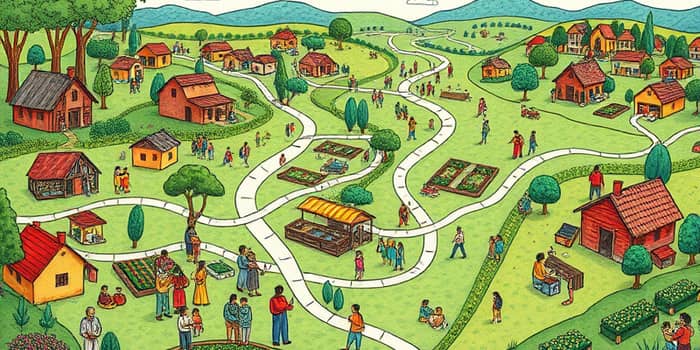
Across centuries, extractive practices have shaped communities and ecosystems, leaving deep scars on the social and natural world. Today, we stand at a crossroads: continue down a path of depletion or embrace a transformative vision of exchange and regeneration. By harnessing the lessons of history, empirical experiments, and emerging frameworks, we can ignite a constructive and synergetic economic system that uplifts people, societies, and the planet.
Extractive economies revolve around removing resources—minerals, timber, labor—to fuel distant markets, often generating local underdevelopment. From the colonial rubber rush in the Amazon to modern outsourcing of manufacturing, extraction leads to demographic collapse and ecological degradation. Infrastructure, once built, tends to serve transient interests rather than local prosperity.
Researchers emphasize the need for time-lagged analysis of commodity sequences to reveal cumulative harms. Each wave of extraction—rubber, oil, minerals—deepens social fractures and erodes resilience. Such models show why regions remain trapped in cycles of poverty despite resource abundance.
In stark contrast, prosocial and regenerative economies focus on building local capacity and circulation. These systems channel money, knowledge, and energy back into communities, amplifying vitality and innovation. Anchored in a common-cause culture of shared purpose, they foster trust and collective stewardship.
Key metrics for regenerative success include inclusivity, resilience, balance, reciprocity, and circulation. Together, these five pillars sustain economic life and reduce fragility. Examples include community banks in cooperative franchises, local currencies that stabilize exchange, and urban neighborhoods designed for real-economy circulation.
Transitioning to a prosocial economy involves understanding both theory and practice. Cultural evolution and group selection underscore how altruism and cooperation at the intergroup level can prevail when structures reward collective success. Economic experiments reveal that default settings—nudges—can temporarily steer behaviors toward conservation, while institutional support ensures long-term sustainability.
Social capital frameworks categorize assets into human, natural, community, civic, and intellectual capital. Dense civic networks—neighborhood associations, cooperatives, clubs—amplify mutual benefit. In metropolitan regions, these networks drive innovation and trust, turning social ties into productive inputs for growth.
Controlled experiments on common-pool resource dilemmas demonstrate that prosocial defaults reduce over-extraction below Nash equilibrium for a period. While effects fade without reinforcement, they highlight the power of design in shaping group coordination. Conversely, exploitative defaults temporarily boost extraction, underscoring the ethical and practical costs of coercive settings.
Field studies correlate prosocial policies—like local hiring and community reinvestment—with stronger job creation, higher trust levels, and more cohesive societies. Regions that embrace community currencies and cooperative banking consistently outperform extractive counterparts in resilience and social health.
To operationalize a prosocial economy, organizations and communities can follow these flexible phases and principles:
Complementing these phases, businesses should treat partners as valued collaborators, not exploited participants, view regulations as social norms to uphold, and avoid price discrimination that harms vulnerable groups. These guiding principles foster trust and align profit motives with societal well-being.
Adopting prosocial economies yields a host of benefits. Communities see enhanced job stability, stronger civic engagement, and improved environmental stewardship. Financial systems anchored in local banks and currencies buffer against external shocks, while knowledge-sharing networks accelerate innovation.
On a global scale, integrating social, economic, and ecological goals contributes to planetary flourishing. As cultural evolution theory suggests, groups that coalesce around mutual support and adaptive learning outcompete extractive peers, setting the stage for widespread resilience and prosperity.
The journey from extraction to exchange is neither quick nor simple, but it is imperative. By supporting local experiments, adjusting policy defaults toward cooperation, and investing in common-cause initiatives, each actor—citizen, business, or institution—can fuel a positive feedback loop of regeneration.
Now is the moment to co-design our economic future. Let us harness shared values and collective agency to power a prosocial economy that honors people and planet alike. The tools exist; the evidence is clear; the choice is ours.
References