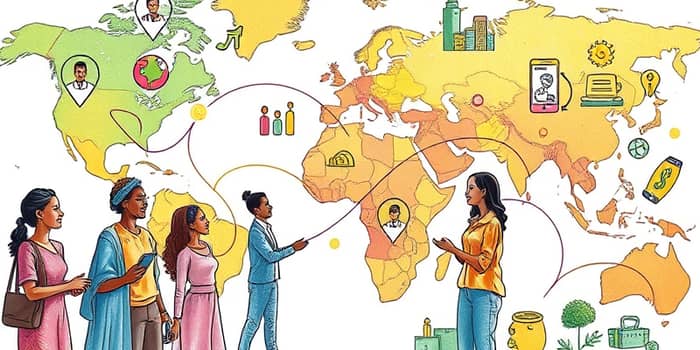
In an era defined by rapid economic change and widening disparities, the notion of equitable access to capital has never been more urgent. Inclusive capital reframes traditional financing by focusing on underserved communities, ensuring that funds are patient, affordable, and mission-aligned rather than purely profit-driven.
While financial inclusion often centers on account ownership and digital payments, inclusive capital goes further by designing instruments that actively close gaps by race, gender, geography, and income. It empowers individuals and micro, small, and medium enterprises (MSMEs) with the resources they need to thrive, build resilience, and contribute to sustainable growth.
Inclusive capital can be viewed as an intentional blend of finance and social purpose. It encompasses equity investments, debt instruments, and blended finance vehicles that prioritize both financial returns and positive community impact. Unlike conventional capital, it seeks to be sustainably accessible to underserved populations over the long term.
At its core, this approach aligns with broader definitions of financial inclusion, which emphasize universal access to formal services—accounts, savings, payments, credit, and insurance—that are affordable, useful, and safe. Inclusive capital extends these principles by embedding mission-driven metrics, such as job creation in low-income neighborhoods or climate resilience in vulnerable regions.
Over the past decade, global account ownership has soared from 51 percent in 2011 to 76 percent in 2021, according to the World Bank’s Findex. Yet progress masks stark regional disparities and persistent unbanked populations, particularly in the world’s lowest-income economies.
Many adults remain excluded, and the scale of unmet financing needs for MSMEs reaches into the trillions of dollars. Inclusive capital must address not only basic access but also the quality and alignment of financial products with community priorities.
This table highlights regional disparities and underlines the need for overcoming systemic financial barriers that still prevent hundreds of millions from accessing basic services.
Digital financial services have reshaped inclusion, with mobile money accounts surpassing 850 million registrations globally. Daily transactions now exceed $1.3 billion via mobile wallets, offering speed, security, and transparency.
In low- and middle-income countries, digital payments adoption jumped from 34 percent in 2014 to 62 percent in 2024. Fintech platforms enable remote communities to receive remittances, pay bills, and build credit histories without visiting a branch.
By combining traditional institutions with agile technology, stakeholders can deliver lower-cost, more transparent financial services that bridge urban–rural divides and empower users with real-time data on their finances.
Despite gains, certain populations remain marginalized by geography, gender, and socioeconomic status. Rural residents, informal workers, and communities of color often face multiple barriers that traditional finance fails to address.
These obstacles perpetuate cycles of poverty and limit the potential of small businesses that could drive local growth. Closing these gaps requires targeted products—microloans, savings groups, and insurance—that meet people where they are.
Community Development Financial Institutions (CDFIs) have emerged as champions of inclusive capital. They specialize in delivering services to historically underinvested communities, offering small-business loans, affordable housing finance, and technical assistance.
By prioritizing mission over maximum returns, CDFIs bridge the racial wealth gap and foster resilience. They collaborate with governments, philanthropy, and private investors to scale impact and drive transformational change.
However, many community lenders face capital constraints—reliance on short-term funding or high-cost deposits limits their ability to meet rising demand. Treating their capitalization as essential economic infrastructure is a vital next step.
Global capital flows reveal both challenges and opportunities. Official remittances to emerging markets totaled $630 billion in 2022, a lifeline for countless families. Meanwhile, venture capital and impact investors are increasingly directing funds toward inclusive fintech startups.
Blended finance structures, which combine public, private, and philanthropic capital, are unlocking billions for climate resilience, affordable housing, and women-led businesses.
Strategic investors craft innovative vehicles—social bonds, guarantee funds, and catalytic equity—to de-risk projects and mobilize larger pools of capital toward underserved regions.
Inclusive capital represents not just a financial instrument but a social commitment. It empowers individuals and microenterprises to weather shocks—economic, health, or climate—by providing savings, insurance, and emergency credit options.
Policymakers, investors, and community leaders must collaborate to expand support for diverse financial institutions, harness digital innovation, and embed equity metrics into every investment decision.
By championing mission-driven, long-term capital, we can unlock new opportunities, spur sustainable growth, and pave the way for a future where everyone, everywhere, has a chance to prosper.
References