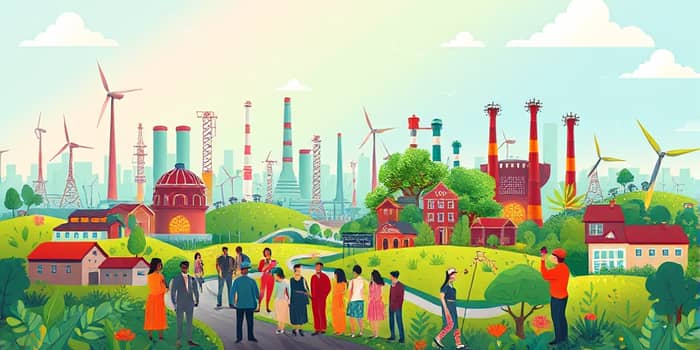
The journey from extractive economic models toward regenerative systems hinges on more than technology; it demands a fundamental shift in how we mobilize resources, distribute power, and ensure no one is left behind. A just transition seeks to embed fair, inclusive, and rights-based principles into every funding decision. This article explores why financing matters, who steers the funds, and how genuine empowerment can replace entrenched exploitation.
For decades, fossil-fuel and extractive economies thrived on a core-periphery dynamic. Wealthy industrial hubs extracted resources, while mining and drilling regions endured pollution, job insecurity, and health crises. The burdens of climate change and degraded environments often fell on communities already marginalized by race, income, or colonial history.
These patterns persist when funding remains controlled by centralized authorities or large corporations. Without community voice, capital flows reinforce inequality, perpetuating opaque decision-making and power imbalances that deepen social and environmental harms.
A just transition reframes the shift to a low-carbon future as a chance to empower frontline workers and communities. It demands three dimensions of justice:
International guidelines, such as the ILO’s 2015 framework, emphasize social dialogue, decent work, social protection, and environmental integrity. Yet translating principles into practice requires transparent funding structures, accessible finance for local projects, and governance models that center affected communities.
Worldwide, governments and multilateral institutions have adopted just transition language in climate plans. South Africa’s national framework and Germany’s coal exit laws demonstrate varied commitments to social protection and fossil-fuel phase-out. Success hinges on aligning national strategies with international principles and ensuring that policy commitments come with adequate finance for transition.
Key elements to assess in any framework include:
The European Union’s Just Transition Mechanism (JTM) offers a concrete model for mobilizing funds in the regions hardest hit by decarbonization. Designed to leave no one behind, the JTM aims to mobilize €55 billion for 2021–2027, primarily in coal and carbon-intensive territories.
The three pillars of the JTM are outlined below:
Territorial Just Transition Plans (TJTPs) require member states to identify regions, set 2030 objectives, and outline governance structures. Yet critical questions remain: are coal workers and marginalized groups truly at the decision-making table, or do national governments and large utilities dominate the process?
Other multilateral and national funds contribute to just transition goals, but often in fragmented ways. Horizon Europe, the LIFE Programme, and the Innovation Fund support research and clean technologies, while the Modernisation Fund aids lower-income EU states. In the United States, state-level Just Transition Funds combine public budgets, carbon pricing revenues, and philanthropy.
This mosaic of funding risks becoming techno-industrial policy with minimal social impact unless governance ensures that local actors control resources and shape project priorities.
Finance can only drive justice if accompanied by transparent governance. Empowerment requires:
Without these elements, funding risks reinforcing existing power structures, channeling capital to large firms, and sidelining small businesses or grassroots initiatives.
Health is often the missing pillar in just transition debates. Fossil-fuel industries produce significant morbidity and mortality, yet few funding streams integrate holistic health systems. Incorporating healthcare infrastructure, accessible care, and environmental remediation can deliver co-benefits for labor, climate, and community well-being.
Programs that connect job training with health services, for instance, can reduce cumulative burdens of pollution, create new green-career pathways, and foster resilience among the most vulnerable.
To transform extractive models into regenerative economies, stakeholders must adhere to these guiding principles:
A just transition is not merely a policy add-on; it is a pathway to rebuild communities, restore ecosystems, and redefine prosperity. By shifting control of capital and governance to those most affected, we can dismantle exploitative legacies and unlock the full promise of a regenerative, empowered economy. The time to fund this transformation is now—building a future where justice and sustainability go hand in hand.
References