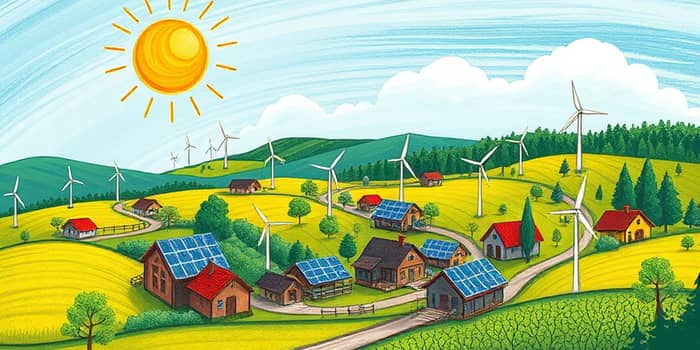
In a world craving resilient solutions, local energy systems offer a path to renewal.
The shift from sustainability to regeneration marks a profound evolution. While sustainable models aim to maintain resources at current levels, regenerative systems go further: they actively regenerates natural and social capital. This approach not only halts degradation but reverses it, nurturing ecosystems and communities alike.
A regenerative economy seeks to:
Localization lies at the heart of regeneration. Centralized, extractive systems have eroded local traditions and economic autonomy, undermining resilience. By contrast, a local regenerative economy puts communities in control, meeting needs first within their own regions and circulating wealth locally.
Key design steps adapted for energy include:
These principles foster long-term ecological and social health while creating new local jobs, increasing autonomy, and keeping energy dollars circulating within the community.
Regenerative agriculture restores soil, water, and biodiversity through holistic practices. We can draw a direct parallel: the regenerative grid is the energy system equivalent of regenerative agriculture. Just as farmers rebuild soils, communities can rebuild energy landscapes.
At the hardware level, regeneration requires more than renewables alone. It demands smart, flexible systems that mirror lab-grade four-quadrant operation and high efficiency found in industrial simulators. Key technical features include:
These components allow every household, business, and electric vehicle to become a prosumer—both a consumer and a producer—integrating seamlessly with the local network.
Transitioning to regenerative grids also means rethinking ownership. Traditional investor-owned utilities often prioritize shareholder returns over community needs. Regenerative models propose:
These structures embed energy as a shared resource, not merely a commodity. They enable viewing human society as Earth stewards, aligning financial incentives with ecological restoration.
Effective policy is the linchpin. Multi-level frameworks must:
Such nested policies ensure local experiments can scale and adapt, fostering wide adoption of regenerative grids.
Communities embracing regenerative grids enjoy tangible benefits:
Increased local job creation through installation, maintenance, and administration roles.
Enhanced energy security by reducing reliance on long-distance transmission and volatile fuel markets.
Lower overall costs as renewable generation moderates and stabilizes prices over time.
Moreover, local ownership ensures that energy revenue reinvests in community services, schools, and ecological restoration projects, reinforcing a virtuous cycle of regeneration.
The regenerative grid stands at the convergence of technology, ecology, and community empowerment. By harnessing distributed renewables, smart hardware, and innovative ownership, it offers a blueprint for rebuilding local economies and ecosystems in tandem.
As we face climate, biodiversity, and social crises, the choice becomes clear: persist with extractive models that fracture communities, or embrace regeneration and spark a renaissance of local resilience. The regenerative grid lights the path toward a future where energy not only powers our lives but restores the world around us.
References