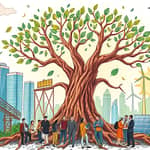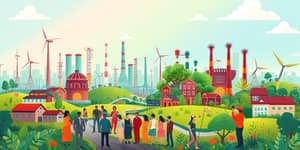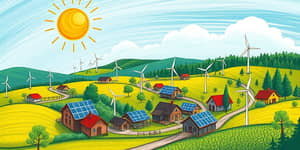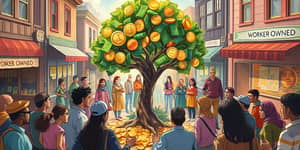
As we face unprecedented environmental and social challenges, the concept of a Harmony Economy emerges as a beacon of hope. By centering human and planetary well-being over mere output, this model reshapes how we measure progress and design systems of value.
Instead of relentless GDP growth, the Harmony Economy prioritizes quality of life, ecological regeneration and equitable opportunity. It synthesizes insights from well-being economics, regenerative design, and sustainable development to create a holistic blueprint for a prosperous future.
The limitations of our current GDP-centric model are increasingly evident. Traditional measures ignore vital factors like social cohesion, environmental health and resilience. In an era of the polycrisis—where climate, nature, inequality and economic instability intertwine—our metrics must evolve.
Economic activity today often exceeds the planet’s regenerative capacity, resulting in environmental overshoot and biodiversity loss. We measure what we can count, rather than what truly counts for people and planet. This mismatch drives systemic destabilization and erodes trust in institutions.
Inequality magnifies these problems. Wealth and power concentrate in the hands of a few, while the less privileged shoulder the brunt of pollution, health risks and climate damage. There is no inherent trade-off between prosperity and ecological integrity—only between entrenched power and shared flourishing.
By reorienting policy to grow the good and shrink the bad, we can address both social injustice and environmental degradation. A Harmony Economy demands an egalitarian distribution of resources and robust safeguards for the natural systems upon which we all depend.
A core pillar of the Harmony Economy is the well-being framework, which measures progress through diverse lenses—health, education, social connection, sustainability and equity. This approach asks: What is the economy for, and whom does it serve?
The United Nations’ Sustainable Development Goals (SDGs) provide a practical blueprint for this transformation, integrating economic, social and environmental objectives. By adopting the SDGs, countries can align national policy with a circular, solidarity-based economic model that leaves no one behind.
By operationalizing these five Ps, governments, businesses and communities can co-create value that is measured not only in financial returns but in improved lives, restored ecosystems and resilient societies.
Building on well-being and sustainability, regenerative economics offers eight guiding principles to animate a Harmony Economy. These principles draw inspiration from natural systems and indigenous wisdom to foster regenerative vitality rather than extractive growth.
Together, these principles offer a blueprint for systems that learn, evolve and cultivate long-term balance with natural systems. By honoring local context and global interdependence, regenerative economies can spring forth from the grassroots and reshape global markets.
Transitioning to a Harmony Economy requires tangible actions by stakeholders across sectors. Public policy, private capital and civil society must coalesce around shared goals to invest in health, education, renewable infrastructure and ecosystem restoration.
These strategies illustrate how governments can enact policies, how investors can align capital with impact, and how communities can lead regeneration efforts. When coordinated, they create a positive feedback loop: thriving ecosystems support healthy communities, which in turn fuel resilient economies.
By investing in healthcare, education, and equality, we unlock human potential. By restoring forests, soils and watersheds, we secure life-sustaining services. These complementary investments break the false choice between social progress and ecological health.
A Harmony Economy is not a utopian fantasy but an emergent reality. Cities around the world are piloting well-being budgets, regenerative agriculture networks are flourishing, and impact investors are demonstrating competitive returns alongside social and environmental benefits.
It is time to embrace an economic paradigm that recognizes our interdependence with the living world. By harnessing the insights of well-being economics, regenerative design and sustainable development, we can chart a course toward a future where prosperity is measured in thriving lives and flourishing ecosystems.
Together, we can co-create a Harmony Economy—one that truly invests in people and planet, ensuring that both prosper for generations to come.
References