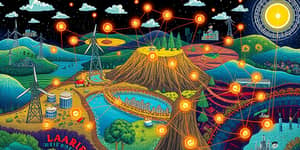
In a world of rising climate risks and economic uncertainty, finance can no longer be treated as a cold, mechanical system divorced from nature. By embracing an ecological mindset, we can transform capital markets into regenerative forces that nourish both people and planet.
This article explores how viewing finance as a complex, adaptive, interdependent living system reveals new pathways to resilience, diversity, and long‐term prosperity.
Traditional economic models liken markets to machines—predictable, rational, infinitely scalable. But history shows that bubbles, crashes, and crises emerge whenever models ignore adaptation and diversity.
The Adaptive Markets Hypothesis reframes markets as evolutionary ecosystems: hedge funds, banks, regulators, and investors act like competing species. They innovate, adapt or go extinct, driving the system through cycles of boom and bust.
Like forests, healthy financial ecosystems flourish on diversity. A monoculture of mega‐banks may deliver high short‐term yields, but becomes vulnerable to systemic collapse when shocks arrive. Natural ecosystems, by contrast, thrive through redundancy, mutual support, and feedback loops.
The New Economics Foundation describes a productive financial ecosystem as one that is diverse, distributed, and capable of sustaining specialized forms of life. We can learn from three core ecological principles:
In practice, a resilient finance system includes credit unions, regional banks, green investment banks, public banks, and mutual funds. These institutions occupy different niches, ensuring capital flows to underserved communities and sustainable sectors even during downturns.
NEF’s allocation function urges finance “to deploy economic resources spatially and temporally to maximize long‐term social and environmental returns under uncertainty.” By focusing on long‐term resilience and ecological alignment, capital steers toward regenerative projects.
Traditional risk models assume a stable planet and linear change. Yet climate tipping points and biodiversity collapse introduce non‐linear shocks that ripple through economies.
Research from Stockholm Resilience Centre highlights how finance actively shapes the Earth. When capital funds deforestation and fossil fuels, it degrades ecosystems, triggering disasters that rebound as financial losses.
Unless finance integrates scientific knowledge of climate and biodiversity, it remains exposed. We must move beyond narrow ESG scores and adopt double materiality impact assessments—measuring both how nature risks finance and how finance risks nature.
Sustainable finance markets are expanding rapidly. Instruments such as green bonds, nature performance bonds, and biodiversity credits channel capital into regenerative projects.
Policy innovations—carbon pricing, mandatory biodiversity disclosures, and risk‐weighted capital requirements aligned with planetary boundaries—can accelerate the living economy transition.
By integrating satellite data, ecosystem models, and robust metrics into risk frameworks, financial institutions can identify systemic vulnerabilities and create reinforcing feedback loops where healthy ecosystems lower insurance costs and attract more capital.
We stand at a crossroads. Treating finance as an ecosystem rather than a machine unlocks powerful tools for resilience, diversity, and systemic health.
By demanding transparent science‐based reporting, supporting a polyculture of institutions, and investing in nature‐positive infrastructure, we can build a living economy that sustains both people and planet.
Together, investors, policymakers, and citizens can cultivate a financial system that mirrors the vitality of a thriving forest—dynamic, interconnected, and endlessly regenerative.
References