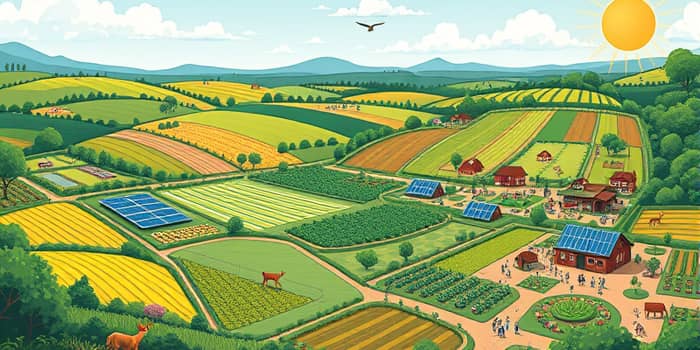
The world today grapples with a polycrisis of the modern world—climate breakdown, resource depletion, widening inequality, and economic instability. Each crisis feeds the others, creating a feedback loop of social and environmental harm. Yet within this challenge lies a profound opportunity: to shift from extractive models toward regenerative systems that restore our planet and uplift our communities.
Our core framing is simple yet powerful: regenerative economies pay a dividend shared by the planet, its inhabitants, and the global economy. By embracing agriculture, finance, and industry practices that heal rather than harm, we unlock measurable return on investment in environmental restoration, social equity, and economic resilience.
Global research confirms that this transformation is not only desirable—it is essential for long-term prosperity. A shift to regenerative and sustainable models could generate an astonishing $26 trillion economic benefit and create 65 million new jobs by 2030, according to the Global Commission on Economy & Climate. Circular economy initiatives alone represent a $10 trillion opportunity and promise substantial waste reduction.
Countries leading with green investments experience an average of 6.5% higher GDP growth relative to extractive counterparts. The European Union’s push toward regenerative practices targets a 48% reduction in greenhouse gas emissions by 2030 versus 2014 levels. Nature-based solutions, from agroforestry to coastal restoration, could lift one billion people out of poverty while securing vital ecosystem services.
Agriculture is at the vanguard of this transformation. In the United States, regenerative practices like no-till farming and cover cropping have already begun to reshape yields, profits, and livelihoods. Across 180 million acres of corn and soy, 80% adoption of these practices could yield an incremental value of $250 billion over ten years, translating to $20–60 per acre annually through increased net income, higher land values, and ecosystem service payments.
Farmer return on investment for switching to regenerative methods ranges from 15% to 25%, driven by lower input costs, greater resilience to extreme weather, and new revenue from carbon and biodiversity credits. Profit margins on regenerative farms are 20–30% higher than conventional operations, while job density increases by 32%, fostering rural renewal and drawing young farmers to the land.
Regenerative economies are built on the principle of shared prosperity. Today, the poorest 50% of humanity earn less than 15% of global income and account for only 10% of lifestyle emissions, while the richest 10% capture over 40% of earnings and nearly half of emissions. Rebalancing this inequity is both a moral imperative and an economic catalyst.
Proposals such as wealth taxes on the top decile, IMF-led investments of $1 trillion per year in green job programs for low-income nations, debt relief, and universal basic dividends from resource revenues could rebalance incomes and fund a green transition. In rural communities, regenerative agriculture delivers stability, fosters social inclusion, and empowers marginalized groups through new revenue streams and skill development.
Consumer demand underscores this shift. In the UK, 41% of shoppers prioritize biodiversity, 46% seek greenhouse gas reductions, and 45% value climate resilience when purchasing food. This growing market preference aligns commercial incentives with ecological restoration.
The transition rests on five guiding principles: sufficiency, circularity, systems thinking, redefined value, and equity and justice. Together, they form a blueprint for businesses and governments to embed systems thinking across operations and reorient metrics toward human and planetary flourishing.
Innovative models bring these principles to life. The Regenerative Renaissance initiative with the Colville Confederated Tribes combines Indigenous wisdom and modern techniques across local food hubs, geodesic growing structures, community entrepreneurship, and smart nutrient-dense farming. BioFi’s bioregional financing facilities channel capital like water through community trusts and venture studios, empowering Indigenous entrepreneurs from California to the Amazon.
Additional pilots such as the Kansas Wheat Farmer study outline scalable frameworks for transitioning commodity crops, while “Rewilding Money” networks foster bioregional economies that regenerate landscapes and livelihoods. Each demonstration proves that regenerative approaches can outcompete extractive legacies.
Transition is not without challenges. Upfront costs averaging $200 per acre, concerns over short-term yield dips, market volatility, and entrenched financial systems all resist change. But policy levers, technology, and collaborative finance can dismantle these barriers.
By aligning incentives with long-term resilience rather than short-term extraction, governments and businesses can unlock capital flows that prioritize ecological health and equitable prosperity.
The regenerative dividend is not a distant dream—it is unfolding now, driven by innovation, evidence, and collective will. Every stakeholder, from farmers and financiers to policymakers and consumers, has a role in securing this shared prosperity.
As we confront the intertwined crises of our age, the pathway forward is clear: adopt regenerative models that restore natural systems, elevate communities, and sustain economic growth. In doing so, we ensure that the true dividend of our economies is life—thriving, abundant, and shared by all.
References