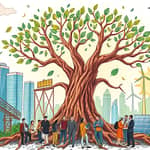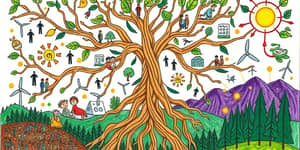
The emerging field of Regenerative Finance (ReFi) offers a profound shift away from extractive models and toward nourishing, sustainable economies. By focusing on restoration projects, equitable governance, and community-led initiatives, ReFi channels capital not for fleeting financial gains but for enduring systemic health across ecological and social landscapes. It represents a paradigm where money circulates like nutrients, fostering resilience and abundance.
In a world grappling with climate breakdown, biodiversity loss, and widening inequality, ReFi presents a pathway to align investment with ecological and human flourishing. This article explores the concept of network effects in ReFi, showing how expanding connections can exponentially amplify impact, drive transparency, and democratize access to resources.
Regenerative Finance stands apart from traditional financial paradigms through its unwavering commitment to environmental stewardship and social equity. At its core, ReFi prioritizes multidecade horizons and systemic impact and integrates metrics that go beyond profit, valuing biodiversity, soil health, water cycles, and communal wellbeing.
Rooted in regenerative economics and living systems theory, ReFi views wealth holistically—embracing natural, social, cultural, human, built, and financial capitals. It advances innovative, adaptive, responsive practices that learn from shocks such as extreme weather, economic downturns, and social upheaval, continuously refining approaches for long-term resilience.
Network effects occur when the utility of a system grows alongside its participant base. Classic examples include social media platforms and payment networks, where each additional user increases overall value. In finance, more liquidity providers mean tighter spreads and deeper markets, while data aggregation improves models and risk assessment.
Regenerative Finance extends these dynamics beyond economics into ecological and social realms. As more people, communities, and institutions join ReFi protocols, the collective intelligence around restoration improves, collaborative capital pools expand, and methodologies evolve. The result is diverse funding mechanisms and robust ecosystems of practice, where each node strengthens the whole and accelerates shared learning.
Within ReFi, direct network effects enhance market efficiency for impact assets. A growing network of carbon credit buyers and sellers leads to more accurate pricing and resilient liquidity. Complementary services—such as insurance for restoration projects and education platforms—create indirect network effects by enriching the ecosystem of support.
Data network effects drive continuous refinement of outcome measurement. On-chain registries accumulate verifiable records of carbon sequestered, habitats restored, and social benefits delivered. Algorithms leverage this dataset to improve credit ratings, project risk profiles, and predictive impact models, thereby reinforcing more informed capital allocation.
Community-driven feedback loops further enhance social network effects. As local stakeholders participate, they contribute traditional ecological knowledge, governance insights, and cultural perspectives. This fosters inclusive decision-making and benefit sharing, ensuring that those most affected by environmental change shape priorities and reap rewards.
Consider a community-led reforestation DAO that tokens trees for monitoring. As more landowners, scientists, and investors join, they share data on growth rates, soil moisture, and biodiversity. This expanding dataset attracts new participants, improves verification processes, and increases funding—creating a virtuous cycle of restoration and learning.
Blockchain and distributed ledger technologies underpin many ReFi platforms, offering unprecedented transparency, security, and automation. Smart contracts release funds only when predefined ecological or social milestones are validated on-chain, ensuring trust and accountability between investors and project implementers.
Emerging networks like Hedera Hashgraph, Celo, and proof-of-stake Ethereum forks provide energy-efficient infrastructures to host ReFi protocols. These platforms support global accessibility, allowing anyone with an internet connection to transact, vote in governance, and propose new impact projects without traditional intermediaries.
Measurement, Reporting, and Verification (MRV) systems integrate satellite imagery, IoT sensors, and community audits into on-chain oracles. As the volume and quality of data grow, predictive models become more precise, driving stronger transparent on-chain tracking of performance and compelling confidence among stakeholders to scale investments rapidly.
Leading institutions have articulated core principles that guide regenerative systems. These principles highlight why interconnected networks amplify resilience, innovation, and abundance across ecological and social domains.
Harnessing network effects requires intentional design and collaboration. The following strategies can amplify connections, deepen liquidity, and broaden impact across ReFi initiatives:
By implementing these tactics, practitioners can strengthen feedback loops, improve transparency, and create compounding returns—in both ecological and financial terms. Collaborative ecosystems of developers, land stewards, scientists, and investors can co-evolve solutions and unlock new forms of capital that nurture regeneration.
As climate crises intensify and social inequalities deepen, the urgency for transformative finance grows. Regenerative Finance offers a beacon of hope, demonstrating that capital can be a tool for healing rather than harm. With each new participant, network effects will compound restoration efforts, resilience building, and equitable governance structures.
We invite you to join this movement. Explore ReFi protocols, share knowledge, contribute data, or invest in projects aligned with ecological and social regeneration. Embrace the vision of democratized access and stakeholder engagement to co-create an interconnected financial system that sustains life and uplifts communities. Together, we can capitalise on connection to build a thriving, regenerative future.
References