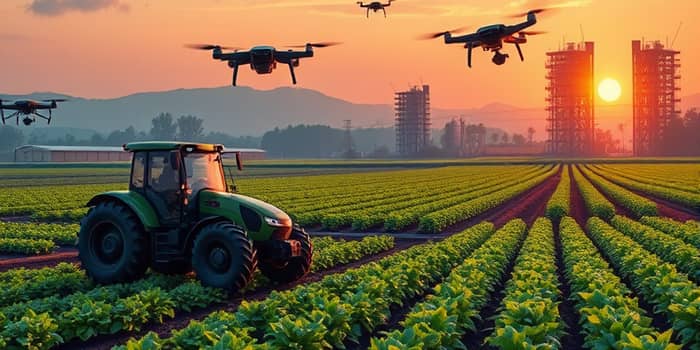
As the world’s population edges toward 9.7 billion by 2050, feeding billions sustainably has become both a moral imperative and a massive economic opportunity. Agritech—where agriculture meets cutting-edge technology—is emerging as a beacon of hope. From precision sensors in the soil to AI-driven decision platforms, farmers and investors alike are witnessing a profound transformation. This article explores how robust growth driven by sustainability and innovation is reshaping farming, unlocking new revenue streams, and promising a greener future for the planet and its people.
Definitional ambiguity abounds in agritech research, with various firms adopting different scopes. Some include biotechnology and vertical farming, while others emphasize hardware, software, and automation. These varying definitions have produced widely ranging forecasts, offering both optimism and caution to stakeholders.
One consensus remains: the global agritech market is on a steep upward curve. Government funding—through programs such as the EU’s Horizon Europe and US Farm Bill allocations—has catalyzed public-private partnerships. Meanwhile, private investments soared past USD 27 billion in 2023, marking a 19% increase over the previous year.
This spectrum—from roughly USD 32 billion to nearly USD 59 billion by 2030, or even USD 153 billion by 2034—illustrates both the growth narrative and forecast uncertainty. Yet every projection underscores a singular truth: agritech’s rise is unstoppable.
Behind these booming numbers lie a host of technological breakthroughs. From earthbound sensors tracking soil moisture to AI algorithms forecasting yields, each solution helps farmers optimize inputs, reduce waste, and boost productivity. Major agri-equipment manufacturers like John Deere and Kubota now integrate smart technologies directly into their machinery, while agile startups innovate in every corner of the value chain.
Each segment complements the others, forging an interconnected ecosystem. Farmers harness AI insights through IoT sensors mounted on robotic platforms, while biotechnology delivers climate-resilient seeds that thrive under precise irrigation regimes. Innovations operate in concert, creating cumulative value for the entire supply chain.
Capital flows into agritech have swelled, but not without recalibrations. After a post-2021 venture-capital boom—characterized by rising deal counts and lofty valuations—the sector is settling into a more disciplined phase. Investors now prioritize companies demonstrating clear pathways to profitability and tangible on-farm impact.
Precision irrigation and autonomous machinery continue to attract significant backing, yet AI has emerged as an especially enticing subtheme. In 2024, the global AI in agriculture market topped USD 1.6 billion, with forecasts projecting nearly USD 4.9 billion by 2030 at a 24.1% CAGR. A subset focused on generative AI boasts a projected 30% annual growth rate through 2026, highlighting data-driven farming as a core driver of future returns.
While total deal counts have tapered since the frenzy years, capital efficiency has become the watchword. From Q1 2025 to Q1 2026, agritech startups executed 22 equity raises above USD 500,000, totaling around USD 337 million. Investors are channeling funds into segments with proven traction—annual crops, precision tools, and smart field equipment lead the way.
As the sector matures, a set of emerging principles guides both funders and founders. Gone are the days when novelty alone sufficed; today’s winners pair creative breakthroughs with capital efficiency and realistic unit economics and demonstrate measurable farm-level impact and yield gains. Technologies must not only impress in pilot trials but also scale reliably across geographies and farm types.
Investors and growers now converge on a shared vision: predictable returns, risk mitigation, and smooth adoption. Firms that embody these pillars—backed by deployment-ready solutions that fit workflows—are well-positioned to lead the sector’s next wave of expansion.
Agritech stands at the intersection of environmental stewardship and economic opportunity. It offers a blueprint for feeding billions while reducing the sector’s carbon footprint, conserving water, and restoring soil health. Yet realizing this promise demands collaboration among farmers, technologists, investors, and policymakers.
For entrepreneurs, the call is clear: develop solutions that address real pain points on the ground, validate them rigorously, and build partnerships that accelerate scale. Investors must remain patient but discerning, championing ventures with robust business models and measurable impacts. Farmers, as ultimate end users, should engage early, co-create new workflows, and share performance data openly.
Above all, agritech’s green leap can be more than a financial phenomenon—it can become a global movement that nourishes communities, revitalizes ecosystems, and secures the food supply for generations to come. By cultivating both innovation and responsibility, we can harvest a future that is both profitable and sustainable.
References