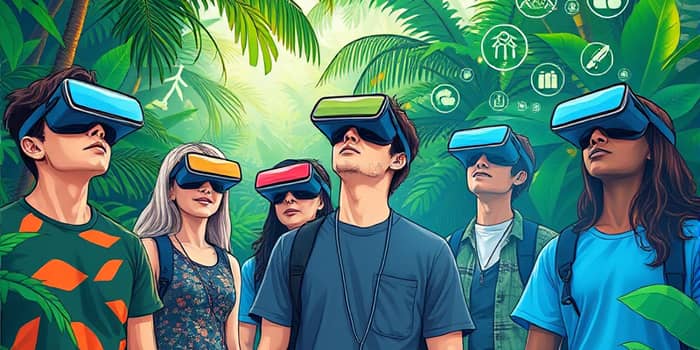
The convergence of immersive technologies and environmental stewardship has opened unprecedented avenues for combating climate change. By harnessing augmented reality (AR) and virtual reality (VR), innovators are creating powerful experiences that foster empathy, drive behavior change, and unlock new investment frontiers.
AR and VR platforms are no longer confined to gaming and entertainment. They now provide immersive experiences in threatened ecosystems while delivering actionable insights to users worldwide. From simulating melting glaciers to overlaying real-time carbon data on physical objects, these tools cultivate a profound emotional connection to planetary challenges.
Such technologies facilitate deep emotional engagement, making abstract concepts like rising sea levels tangible. They lower the barrier to climate literacy, enabling stakeholders—from students to policymakers—to witness future scenarios before they manifest.
Across sectors, AR/VR applications are reshaping educational models, consumer behaviors, and industrial processes. Key examples include:
These use cases not only generate measurable environmental benefits but also create scalable business models. By embedding sustainability at the core of product design and marketing, companies can tap into an expanding market of eco-conscious consumers and stakeholders.
Research underscores the efficacy of immersive learning in promoting pro-environmental attitudes and behaviors. A study by Gifford et al. (2011) found that users exposed to VR climate disasters exhibited heightened conservation motivations and reduced carbon-intensive actions.
Similarly, Hamari and Koivisto (2018) demonstrated that gamified VR scenarios boost student retention of sustainability concepts by over 30%. AR-driven consumer tools have also shown a 20–25% improvement in eco-friendly purchasing decisions (Hamari et al., 2016).
The AR/VR climate technology sector is poised for significant growth, with projected market expansions exceeding 25% annually. Investors can explore multiple segments:
Early-stage investments in these domains not only yield financial returns but also deliver measurable environmental benefits and outcomes. Strategic partnerships with academic institutions, policy bodies, and non-profits can further de-risk innovation and accelerate deployment.
As climate urgency escalates, AR/VR solutions will become indispensable tools for education, design, and decision-making. Investors who champion these technologies can catalyze a paradigm shift toward sustainable development while securing robust returns.
By allocating capital to immersive climate innovations, stakeholders can:
Together, we can harness the power of AR and VR to envision, prototype, and realize a more sustainable future. The time to invest in climate-focused immersive technologies is now—transformative impact and profitable growth await.
References