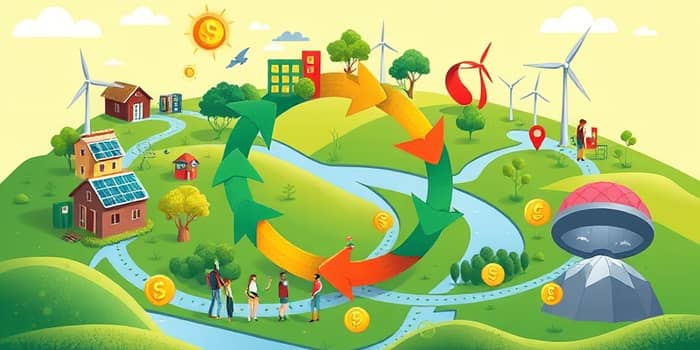
The transition to a circular economy demands visionary financing strategies that break free from traditional linear paradigms. By embracing innovative funding approaches, stakeholders can mobilize capital, de-risk investments, and scale sustainable solutions at the pace our planet requires.
Financing circular initiatives faces deep-rooted obstacles, rooted in market imperfections and barriers that lock-in linear models and hinder new ventures. The prevalence of path dependence and uncertainty further complicates capital allocation, leaving many promising projects stranded.
Unique supply chain dependencies create fresh risks. Projects reliant on limited waste streams or specialized residual flows suffer from high coordination costs and supplier risks, deterring financiers accustomed to established markets. Moreover, the value of long-term benefits—such as reduced environmental impact and resource security—is frequently undervalued by traditional appraisal methods.
A diverse toolkit of instruments is emerging to bridge funding gaps and support circular innovation. Governments, development banks, and private investors are tailoring solutions to address project bankability, scale, and social risk profiles.
While large funds target mature projects, the missing middle funding gap of $50K–$1M remains acute in emerging markets. Early-stage entrepreneurs capture just 9% of equity despite forming half of deal volume, creating a valley of death for scaling circular models.
Overcoming barriers requires coordinated action and tailored risk mitigation:
Investors are beginning to recognize circular models as de-risking versus resource shocks, but inconsistent data and limited institutional capacity hamper progress. Establishing clear standards and impact metrics is crucial for unlocking mainstream capital.
Several high-profile corporations have pioneered circular investments from the sidelines:
In emerging economies, eco-industrial parks demonstrate how shared facilities and coordinated logistics can attract blended finance, leveraging grants, debt, and equity to build resilient circular hubs.
To secure financing, circular economy ventures can follow a structured pathway:
Achieving a truly circular economy demands more than isolated experiments. It requires systemic collaboration and policy support to integrate finance into every stage of product lifecycles. Regulators can set standards, central banks can incorporate circular metrics into risk assessments, and financial institutions can craft innovative products that reward longevity and resource efficiency.
By collectively addressing financing gaps and embracing circular finance as an opportunity rather than a risk, we can unlock transformative benefits: resource regeneration, resilient supply chains, equitable growth, and a healthier planet. The journey from linear dependence to circular prosperity is complex, but with strategic funding, the transition is within our grasp.
Let us move beyond linear thinking and invest in the future we all deserve—a world where capital flows in cycles, not straight lines, and where finance catalyzes regeneration rather than depletion.
References