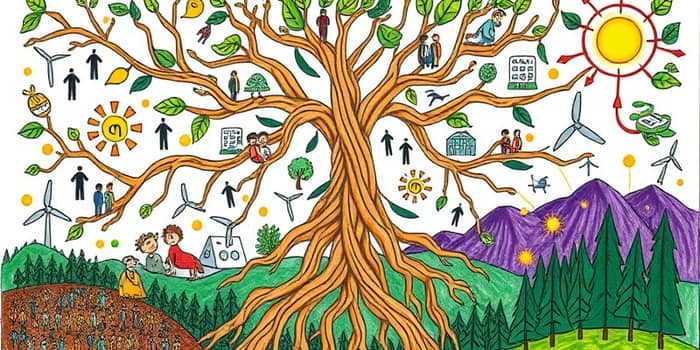
In a world grappling with ecological degradation and social inequities, a new economic vision emerges—one that heals as it grows. The Regenerative Matrix offers a framework to guide capital so that it not only does less harm but actively regenerates and revitalizes ecological and social systems. By weaving together impact, systems, and regenerative investing, this matrix becomes a catalyst for lasting change.
Sustainability efforts often aim for net-zero or reduced harm, yet they can fall short of addressing root causes of degradation. A regenerative economy seeks to restore and renew natural resources, rebuild communities, and foster long-term resilience and wellbeing. It moves beyond extraction by embracing circular approaches, from soil-building regenerative agriculture to community-led renewable energy.
This approach reframes growth: not as infinite expansion of GDP, but as enhancement of natural, social, and built assets. It prioritizes equitable access, climate justice, and the enrichment of all forms of capital, transforming how we define wealth and success.
The Regenerative Matrix rests on a continuum of capital deployment philosophies. At one end lies impact investing, where funds seek measurable social or environmental benefits alongside financial returns. Next comes systems investing, which targets the underlying drivers of systemic challenges. Finally, true regenerative investing aligns strategies with living systems, viewing the investor, investee, and socio-economic context as one integrated whole.
To illustrate, consider the following table outlining the key distinctions:
This framework encourages investors to ask: How does each decision alter capital flows, power structures, and cultural narratives? By integrating all three levels, the matrix ensures that investments drive immediate benefits while building the conditions for long-term resilience and wellbeing.
The macro layer of the Regenerative Matrix leverages public policy and finance to reorient entire economies. Shifting tax regimes, subsidies, and banking structures can unlock vast pools of capital for regeneration.
These levers exemplify how systemic change often begins with policy reforms that reshape incentives, redistribute resources, and empower communities to co-create solutions.
Practical application of the Regenerative Matrix requires collaboration among investors, policymakers, and communities. It starts with mapping local assets, challenges, and potentials using tools like Theory of Change and causal loop diagrams. Stakeholders identify leverage points—policy shifts, cultural interventions, or capital deployments—that can ripple through the system.
For example, a regional regenerative agriculture fund can combine philanthropic grants (gift money) with patient, revolving capital to support farmers transitioning to agroecological methods. Simultaneously, local governments can incentivize renewable energy installations, and community banks can provide low-interest loans for equipment. This orchestrated approach exemplifies how profits are a means, not the end.
To adopt the Regenerative Matrix in your work:
By aligning capital with living-systems principles—circulation, reciprocity, diversity, resilience—we can transform our economic systems into engines of regeneration, equity, and durability. The Regenerative Matrix is more than a framework; it is a call to action for investors, policymakers, and communities to collaborate in creating a future that thrives.
Embracing the Regenerative Matrix means committing to a holistic vision where every dollar fosters ecological renewal, social justice, and enduring prosperity. It challenges us to reimagine wealth, recast risk, and redesign finance to serve life itself. The journey toward systemic regeneration has begun—will you join the movement and shape what comes next?
References