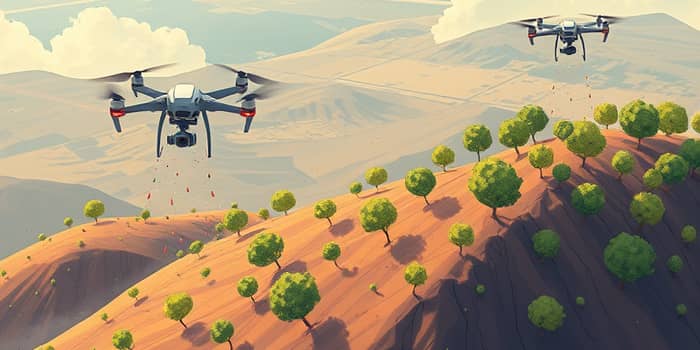
As the world grapples with escalating climate emergencies and biodiversity loss, the rise of drone-powered reforestation offers a beacon of hope. By combining high-resolution satellite imagery with advanced AI, organizations can target degraded landscapes with unparalleled precision. This article explores how cutting-edge UAV systems are transforming restoration efforts into compelling investment opportunities.
Recent breakthroughs in aerial seeding illustrate a paradigm shift in how we approach restoration. Traditional nurseries and planting teams are now complemented by fleets of autonomous systems capable of reaching remote environments in hours, not months. This fusion of robotics, data analytics, and ecological science underpins a new era of resilience building.
The journey begins with comprehensive mapping and analysis. Phase 1 employs satellite data from sources like Copernicus and Planet Labs to identify priority zones and determine suitable native species. These maps feed into AI models that generate optimal planting patterns, ensuring each seed pod lands in a favorable micro-site.
In Phase 2, algorithms refine these patterns by incorporating terrain features, soil composition, and ecological connectivity. The result is a planting blueprint tailored to local conditions, maximizing germination rates and ecosystem recovery.
Phase 3 brings seeds to the sky. Equipped with pneumatic launchers and precision GPS, drones distribute biodegradable seed pods enriched with nutrients at centimeter accuracy. Post-planting, satellite and drone surveys monitor growth, adjust strategies, and report on survival metrics, creating a feedback loop that drives continuous improvement.
This streamlined workflow contrasts sharply with traditional methods, slashing labor costs and deployment time while scaling to remote or steep terrain inaccessible by ground crews.
Several pioneers have demonstrated the viability and impact of this approach. Below is a snapshot of major players in the field:
Investors are taking note. Global forest finance reached $23.5 billion annually in 2024, nearly doubling since 2020. Public funding accounts for 60 percent, while private capital rises to 40 percent.
Recent funding rounds underscore the momentum: DroneSeed secured $36 million in Series A backing and acquired Silvaseed, while Flash Forest raised CAD 11.4 million. Dendra Systems’ partnerships with the World Bank in the Sahel demonstrate large-scale impact and financial traction.
Empirical data highlights dramatic efficiencies. Drone deployments operate at 10 to 50 times faster than manual methods and often cost one-third of traditional planting. Survival rates, initially 0–20 percent in early pilots, are improving through iterative monitoring and design.
These figures translate into both environmental dividends and scalable business models, enabling investors to track returns via quantitative metrics and impact reporting.
Despite successes, obstacles remain. Low germination and early seedling mortality challenge project viability in harsh environments. To address this, researchers at Penn State are developing nature-inspired biomimetic seed coatings that mimic plant defenses and boost resilience.
Looking ahead, emerging drone fleets with swappable payloads and enhanced autonomy promise to expand operational scales. By 2026, eight new systems will join the market, further reducing costs and broadening geographic reach.
Beyond tree counts, reforestation yields profound societal gains. Carbon capture initiatives help countries meet net-zero goals and unlock climate finance channels. Biodiverse forests stabilize soils, purify water, and mitigate extreme weather impacts.
Local communities benefit through job creation in drone operations, maintenance, and monitoring. Programs like ReForest Latam demonstrate how AI, drones, and biotech converge to foster sustainable livelihoods, empowering farmers and indigenous groups.
Furthermore, these initiatives foster collaborations across sectors, aligning corporate sustainability goals with grassroots conservation efforts. Schools, NGOs, and local governments collaborate on monitoring platforms, ensuring transparency and community ownership.
Drone-powered reforestation stands at the nexus of profit and purpose. Investors gain measurable financial returns through carbon markets and cost savings, while ecosystems rebound with renewed life. As technology advances, partnerships between innovators, governments, and impact investors will accelerate the restoration of billions of hectares.
By aligning capital with nature’s rhythms, we can foster a future where restoration is not only an environmental imperative but also a compelling economic opportunity. The sky, quite literally, is the limit.
As investors seek impact alongside profit, drone-assisted reforestation emerges as a cornerstone for sustainable portfolios. With every seed pod launched, we invest in a greener, more equitable planet—one flight at a time.
References