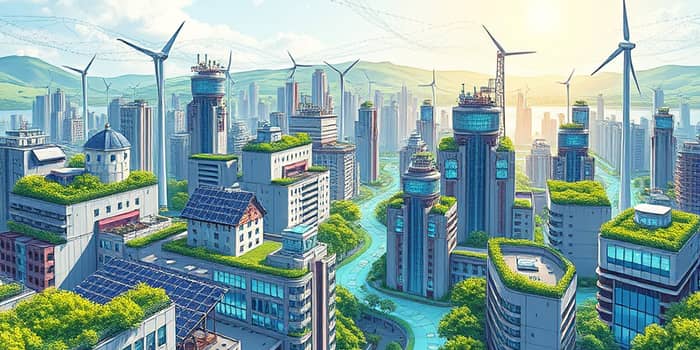
In an era of rapid urbanization and climate urgency, learning to merge cutting-edge urban design with innovative financing is crucial. This article explores how cities can leverage technology and green capital to become resilient, inclusive, and environmentally sound.
At their core, an innovative city that uses ICTs aims to optimize services, reduce environmental footprints, and improve quality of life. The United Nations Economic Commission for Europe describes smart sustainable cities as urban centers that deploy information and communication technologies (ICTs) alongside sustainable practices to foster resilience and livability.
The International Telecommunication Union expands this vision by emphasizing the goal to reduce environmental footprint and enhance quality within urban ecosystems. Smart sustainable cities integrate efficient energy usage, eco-friendly transportation, waste management, and biodiversity preservation to form healthier, more sustainable places for residents.
Financing green urban transformation requires a mosaic of funding instruments and policy frameworks. The UNECE’s full-cycle approach illustrates how cities can progress from evaluation to funding concrete projects through guidelines, recommendations, and a compendium of innovative financing practices.
Key structures have emerged from recent bibliometric analyses, clustering around government initiatives, climate finance, and digital innovations. Governments drive policy frameworks, while climate finance instruments like green bonds fund renewable energy and low-carbon infrastructure. Digital technologies then optimize resource allocation and risk assessment.
To illustrate, consider these common instruments:
Digital finance platforms also play a crucial role by incorporating environmental performance into lending criteria and offering subsidies for electrified transport. As reported, AI-driven credit scoring has achieved a 5.3% predictive accuracy improvement, reducing default rates on green bonds and strengthening investor confidence.
Technological innovation forms the backbone of smart cities. A robust tech stack typically includes AI and machine learning for energy optimization and climate-risk pricing, blockchain for governance transparency, IoT sensors for real-time monitoring, and digital twins to simulate urban scenarios.
Interoperability and open-source standards foster cost-effective, scalable solutions, enabling cities of varying sizes and budgets to adopt best practices without proprietary lock-in.
Several pioneering projects demonstrate how theory translates into impact. In Shenzhen’s International Low Carbon City, stakeholder-inclusive public-private partnerships financed renewable energy, green buildings, and smart mobility networks. This model showcases how stakeholder-inclusive public-private partnerships can accelerate low-carbon transitions at scale.
The Climate Investment Funds Smart Cities Program deploys coordinated investments across mitigation, resilience, and social inclusion in low- and middle-income countries. By partnering with multiple development banks, the program delivers a scalable and replicable climate-smart model of urban growth.
Meanwhile, EDF’s investor strategy is pushing for renewables to power AI and data centers, addressing a projected 10% increase in global electricity demand. Such initiatives highlight growing investor demands for sustainable power in high-tech infrastructures.
Adopting a combined smart-city and green-finance approach yields multifaceted benefits:
However, cities face challenges including policy fragmentation, financing gaps, and technology integration hurdles. Clear policy signals and supportive regulatory frameworks are essential to mobilize private capital and sustain innovation momentum.
Looking ahead, the future of urban sustainability hinges on collaborative governance, digital platforms for citizen engagement, and evolving financial instruments like impact investing and climate adaptation bonds. Embracing a people-centred smart cities paradigm will ensure that technological advancements and green finance serve the broader goal of equitable and liveable urban environments.
Building sustainable urban futures demands a holistic synthesis of smart-city technologies and green-finance mechanisms. By learning from pioneering case studies, leveraging innovative funding models, and prioritizing collaborative policymaking, cities can transform challenges into opportunities. The journey toward greener, smarter cities is ongoing, but with concerted effort and shared vision, urban areas worldwide can thrive as beacons of resilience and prosperity.
References