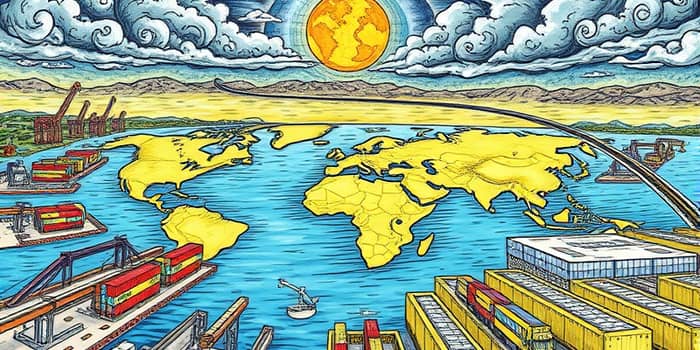
Climate change is no longer a distant threat—it is reshaping every link in global supply chains and demanding a fundamental rethinking of how we invest to protect commerce and livelihoods. As storms intensify, seas rise, and markets shift toward low-carbon solutions, companies and governments face unprecedented pressure to build resilience into their procurement, production, and distribution networks.
In this article, we explore why climate shocks and supply chains constitute a crucial investment issue, examine the types of risks companies face, trace how disruptions propagate through interconnected networks, and outline practical strategies for building more adaptive, robust operations. Leaders who move decisively now can transform potential losses into opportunities for innovation, competitiveness, and long-term growth.
Global supply chains hinge on infrastructure stability and market confidence. Without timely investments to shore up vulnerabilities, firms risk repeated disruptions, cost inflation, and damage to their reputation—and entire economies can feel the shockwaves.
Supply chains today confront two broad categories of climate risk: physical hazards that directly damage assets and slow-burn changes that erode resource availability, and transition risks driven by evolving regulations, technologies, and consumer expectations.
Physical climate risks range from sudden catastrophes—hurricanes, floods, wildfires—to chronic threats such as sea-level rise, heatwaves, and water stress. These hazards can disable ports, roads, warehouses, and production sites, creating ripple effects that halt operations far from the disaster zone.
Meanwhile, transition risks arise as economies decarbonize. New carbon pricing regimes, border-adjustment measures, and stricter emissions standards can suddenly raise costs for carbon-intensive inputs. Firms face liability and reputational exposure if they fail to track and reduce greenhouse gas emissions throughout their upstream suppliers.
Companies that ignore these shifting policy and market dynamics may find themselves paying heavy fines, losing market access, or forfeiting investor support.
A localized climate shock often begins with damage to a Tier 2 or Tier 3 supplier, but its impact rarely stops there. When a supplier halts output, Tier 1 manufacturers lose critical parts, forcing expensive production shutdowns. Downstream, retailers and service providers grapple with stockouts, contract penalties, and lost customer loyalty.
Even advanced economies feel the pain: a major port closure in East Asia, for instance, can create a three-week backlog at distribution hubs in North America and Europe. Companies can expect a significant 1–2 month disruption roughly every 3.7 years if they fail to adapt.
Investing in resilience is fundamentally an insurance decision. Up-front costs—such as mothballing redundant capacity, building elevated facilities, or diversifying supplier bases—can appear to dent profitability. Yet the downside of under-investment is far greater: bankruptcies, enduring revenue losses, and systemic threats to national economic security.
Projected costs of supply chain disruptions underscore the urgency:
Economists warn that the trade-off between efficiency and stability is real: resilience measures can raise input prices and inflationary pressures in the short term. Yet firms that integrate resilience into their core financial planning lock in lower cost of capital, better credit ratings, and stronger investor trust.
Long-term productivity gains and market share wins accrue to first movers that embed climate-smart practices—nearshoring, green infrastructure, digital risk monitoring—while peers scramble to catch up.
Effective resilience hinges on a set of interlocking pillars: risk mapping, diversification, infrastructure hardening, financial instruments, and cross-sector collaboration. Each strategy demands tailored investment and governance frameworks to deliver measurable impact.
By combining these pillars in a coherent investment roadmap, companies can transform supply chain resilience from a cost center into a strategic differentiator. Governments and multilateral institutions also play a critical role by funding public infrastructure upgrades and standardizing resilience metrics for investors.
Public–private collaboration ensures that resilience projects benefit from both commercial discipline and public policy support. Shared risk frameworks, co-financing models, and technical assistance accelerate the adoption of best practices across industries.
Leaders should start by conducting thorough climate stress tests on their supply networks, setting clear resilience targets, and aligning capital expenditures with those objectives. Early wins—such as hardening a single high-risk port or diversifying a critical raw material supply—build momentum and demonstrate value to stakeholders.
Ultimately, building investment for climate shocks is not an optional add-on but a foundational imperative. Firms that embrace this challenge will not only insulate themselves against future disruptions but also unlock cost savings, revenue growth, and enduring competitive advantage.
As climate events grow more frequent and severe, the time to act is now. By channeling capital toward resilience, businesses and nations can safeguard prosperity, protect communities, and chart a sustainable path forward in an unpredictable world.
References