As the world races toward a carbon-neutral future, automation has emerged as a critical catalyst in optimizing renewable energy production. From wind farms to solar arrays and green hydrogen plants, robotics and AI are not only enhancing efficiency but also driving significant cost savings and reliability improvements.
Several powerful trends are fueling the rapid integration of robotics into renewable energy operations. Governments and corporations alike are investing trillions to meet ambitious emission targets, while technology advances are enabling new levels of performance.
These drivers have elevated renewable automation from a niche innovation to a mainstream necessity, unlocking a projected market growth from USD 8.5 billion in 2024 to USD 18.4 billion by 2032 at a 10.5% CAGR.
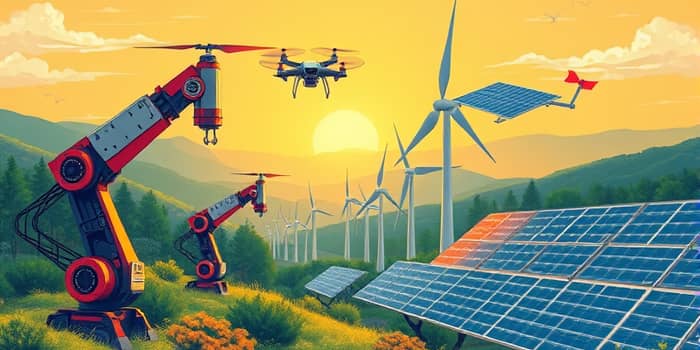
Wind turbine maintenance with robots and precise solar panel installation systems are among the most impactful use cases in the sector. Each application streamlines labor-intensive tasks, reduces downtime and enhances safety.
In wind farms, rope-suspended inspection robots can complete a blade service up to six times faster than manual crews, reducing turbine downtime by a factor of ten. For solar installations, autonomous patrol units deter wildlife and theft, ensuring uninterrupted generation across hundreds of gigawatts of capacity.
Offshore environments pose unique challenges: sub-sea robots inspect submerged foundations, identifying cracks and corrosion before they escalate, while surface drones coordinate with edge computing nodes to adapt operations during storms. At electrolyzer plants, collaborative robots handle delicate assembly and quality control, boosting hydrogen yields and consistency.
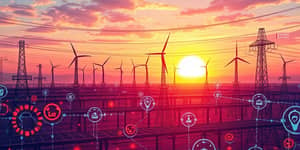
Behind these breakthroughs lies an ecosystem of advanced hardware and software. Predictive maintenance platforms and analytics leverage big data and AI to forecast equipment failures, while advanced sensors and control devices capture real-time conditions across remote sites.
On the hardware side, rope-suspended drones, autonomous mobile robots (AMRs) and specialized sub-sea crawlers handle the most arduous tasks. Cloud computing architectures tie these devices together, while edge computing reduces latency for mission-critical decisions.
Aerones, founded in Riga in 2015, raised series B funding of $62 million to mass-produce wind maintenance robots. Their systems have serviced over 8,000 turbines in 27 countries, cutting service time by sixfold and downtime by tenfold.
In Sweden, Absolicon leverages ABB robots to manufacture solar collectors at a rate of one every six minutes, compared to just three per day by manual methods. This shift illustrates how modular automation solutions and scalability can reshape production economics and carbon footprints.
By integrating robotics into renewable energy, the industry achieves carbon footprint reduction and sustainability goals while slashing operational costs. Automation also supports the United Nations Sustainable Development Goals by lowering resource waste and improving workplace safety.
Looking ahead, hybrid systems combining solar, wind and battery storage will demand even more sophisticated automation controls. Governments in Europe, Asia and North America are offering incentives and regulatory frameworks to accelerate digital transformation in clean energy.
As we stand on the threshold of a renewable revolution, cost-efficient operations and maintenance powered by robotics and AI will be pivotal. By harnessing these technologies, stakeholders can ensure reliable, scalable and sustainable energy for generations to come.
References