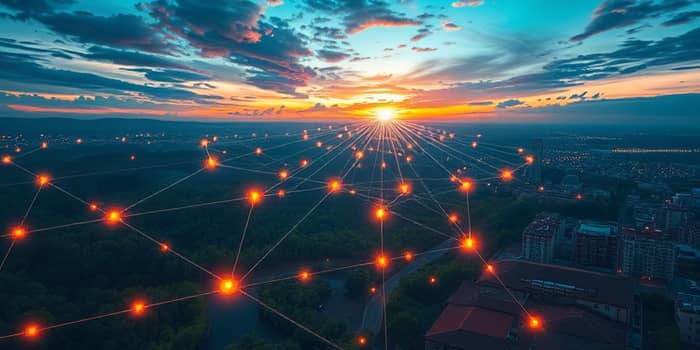
In an era defined by unpredictable weather patterns and mounting environmental pressures, leveraging cutting-edge technology becomes not just advantageous but essential. Spatially dispersed environmental sensors are at the heart of a revolution in how we observe and safeguard our planet. By marrying wireless communication with advanced analytics, these networks deliver unprecedented visibility into atmospheric, terrestrial, and aquatic systems.
From remote Arctic outposts to bustling cityscapes and fertile farmlands, wireless sensor networks (WSNs) gather critical information on temperature, humidity, air quality, soil moisture, water chemistry, wind, and precipitation. Each node silently reports real-time measurements, empowering communities, researchers, and investors to make data-driven decisions that foster resilience against climate change.
At the core of climate monitoring lies the concept of a wireless sensor network: a collection of autonomous devices equipped with sensors, transceivers, and minimal processing power. These nodes communicate over low-power wide-area networks—such as LoRaWAN, NB-IoT, and Sigfox—ensuring long-range coverage with minimal energy consumption.
By deploying these networks at scale, stakeholders gain blanket coverage over sensitive ecosystems and agricultural regions. High-density arrays can map variations as small as half a meter, revealing hidden microclimates that traditional stations miss.
These deployments have already illuminated critical insights: mapping pollutant dispersion in urban river basins, detecting early signs of wildfire risk through humidity and temperature anomalies, and guiding precision irrigation that conserves water without sacrificing yield.
The rapid decline in component costs has democratized access to cost-effective hardware and software solutions. Off-the-shelf microcontrollers and open-source libraries enable researchers and entrepreneurs to customize sensors for specific environments without prohibitive upfront investment.
Meanwhile, the integration of AI and edge computing transforms raw readings into actionable intelligence. AI-driven predictive analytics capabilities allow models to forecast extreme weather events, optimize resource allocation, and detect system faults before they escalate into data gaps.
As climate-related disasters multiply—27 billion-dollar events in the US in 2024 and $162 billion in global losses in early 2025—the economic incentive to invest in resilience technologies has never been clearer. McKinsey estimates a $1 trillion opportunity for private capital by 2030 in climate resilience tech, with sensor networks playing a foundational role.
According to PwC, AI-related climate-tech funding rose from $5 billion (7.5% of total) in 2023 to $6 billion (14.6%) in the first three quarters of 2024. Investors like General Atlantic are backing companies that simulate weather patterns, while venture funds prioritize solutions that deliver measurable risk reduction and cost savings.
By quantifying risk—modeling flood scenarios, property damage from wind events, and crop yield variability—sensor networks unlock new valuation frameworks. Institutions such as BlackRock now offer climate-aware portfolios, reflecting the growing consensus that resilience equals return.
Deploying sensor networks is not without hurdles. Harsh environments can degrade components, while remote installations strain power budgets. Data security and calibration consistency also demand robust frameworks.
Collaborations between academia, industry, and governments are refining these solutions. Testbeds in the Arctic and Amazon rainforest are pioneering modular architectures that adapt to extreme conditions and self-heal networks after node failures.
The horizon is bright for an era of ubiquitous monitoring. Advances in nano-sensors, AI-driven anomaly detection, and global satellite integration promise real-time, high-density data that will redefine predictive environmental science.
Investment momentum shows no sign of slowing. Post-Paris Agreement funding growth, coupled with supportive policies like the US Inflation Reduction Act, ensures that sensor networks remain a priority. As costs fall and performance rises, deploying tens of thousands of nodes will become routine.
Ultimately, these networks embody a powerful vision: a world where every ecosystem is transparent, every risk is quantified, and every stakeholder—from local farmers to global investors—can act with confidence. Embracing this technology today means safeguarding tomorrow and securing sustainable returns on a rapidly warming planet.
References