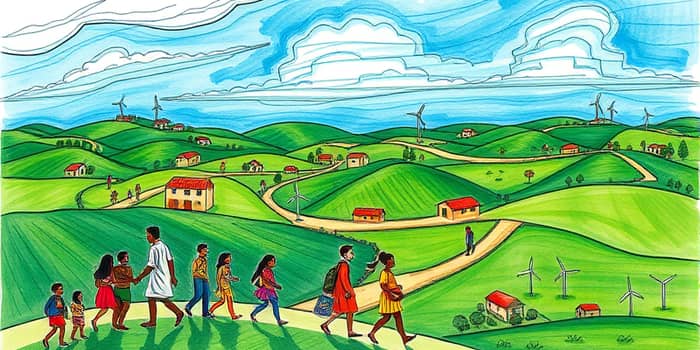
As climate hazards intensify, migration emerges not just as crisis but as a beacon of human ingenuity. Across the globe, communities are choosing pathways that safeguard livelihoods and health, forging new connections between mobility and resilience.
Climate migration encompasses a spectrum of mobility patterns, from temporary or circular movements to permanent relocation and even involuntary immobility. While displacement narratives often dominate headlines, framing migration as a choice reveals it as a voluntary adaptive strategy to secure safety and opportunity when local coping capacity is overwhelmed.
Scholarship now emphasizes migration’s role within a broader adaptive toolkit. Rather than viewing every movement as failure, policymakers and practitioners can harness mobility to strengthen human systems, improve social welfare, and stimulate economic diversification in both origin and destination regions.
Forecasts suggest up to 216 million internal climate migrants by 2050, while high-end scenarios warn of over a billion displacements by mid-century. Yet these figures remain indicative rather than definitive, shaped by evolving adaptation measures and policy choices.
These patterns underscore the complex feedback loops and non-linear pathways that define climate-human systems. Rather than simple cause-and-effect, uneven resource access, governance quality, and social networks shape who moves, where, and when.
Adopting a systems mindset means integrating migration into broader strategies that support livelihoods, public health, and community cohesion. Investments in adaptive systems can transform potential risks into opportunities for renewal and innovation.
Key sectors for targeted investments include safe water infrastructure, diversified agriculture, off-grid renewable energy, and social protection programs that accompany mobile populations. These initiatives build resilience in origin areas while laying foundations for productive settlement in receiving communities.
Emerging visa schemes and legal frameworks demonstrate how governments can embrace mobility. Argentina’s special disaster visa and Finland’s exploratory climate asylum pilot signal a shift toward policy frameworks that embrace climate mobility as a pathway to stability.
Integrating migration into national adaptation plans, establishing cross-border social safety nets, and ensuring access to health, education, and financial services are critical steps. When mobility is supported by legal and institutional structures, migrants contribute to both origin and destination economies through remittances, skills transfer, and cultural exchange.
Local actors often pioneer adaptive migration projects, from cooperatives managing reforestation in drought-prone zones to urban networks offering housing and vocational training for newcomers. These efforts demonstrate the holistic human security and health outcomes achievable when communities lead design and implementation.
Public health experts emphasize that enabling safe, regulated migration pathways reduces exposure to disasters and limits disease transmission. Mobile clinics, mental health support, and vaccination campaigns tailored to migrant routes can dramatically improve well-being.
Addressing climate migration as an adaptive opportunity demands collaborative partnerships across sectors and scales. International agencies, local governments, civil society, and private investors each hold pieces of the solution.
By sharing data, harmonizing policies, and co-financing projects, stakeholders can create corridors of resilience. Early warning systems fitted to migration patterns, blended finance mechanisms for community infrastructure, and peer-to-peer learning platforms ensure that adaptation is dynamic and inclusive.
In embracing adaptive migration, we recognize human mobility as a testament to our collective resourcefulness. Investing in adaptive human systems—rather than resisting change—offers a route to more equitable, secure, and vibrant futures for all.
References