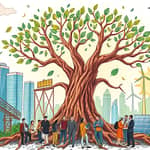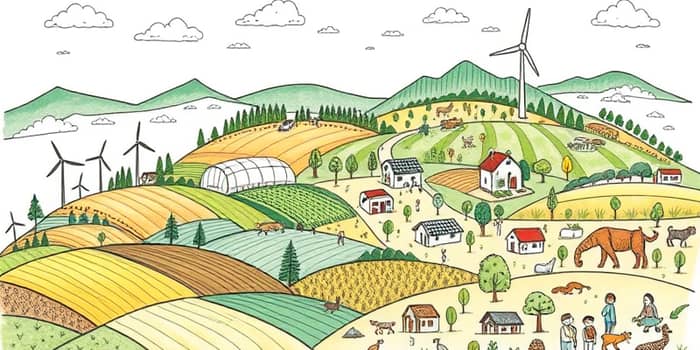
As humanity faces the mounting challenges of climate change, biodiversity loss, and social inequality, a new paradigm emerges: regeneration. This approach envisions a future where economic growth and environmental stewardship are not at odds but interwoven into a single formula. At its core sits a balanced equation where economic returns fuel restoration and vice versa, creating a resilient cycle of renewal.
Drawing on decades of research, case studies, and empirical evidence, this article explores how businesses, governments, and communities can operationalize regeneration as both a guiding principle and a measurable outcome. By aligning profit motives with ecosystem health, we can craft strategies that deliver robust returns while healing the planet.
Regeneration reframes traditional extractive models by defining success as simultaneous gains in economic performance and ecological function. Instead of measuring output solely by revenue or yield, it factors in soil quality, biodiversity, water cycles, and social capital. This approach challenges us to view growth through the lens of interdependence, where every gain in profitability is matched by progress in planetary restoration.
Central to this framework is the concept of planetary health restoration through ecosystems. Human economies are nested within Earth’s biosphere, and regeneration acknowledges that healthy landscapes drive sustainable yields, stable economies, and community well-being. By treating natural systems as partners rather than resources to deplete, regeneration unlocks new pathways to long-term prosperity.
Multiple frameworks outline the guiding principles of regeneration, each emphasizing holistic, adaptive, and inclusive approaches. Among the most influential are ten foundational principles that govern the design and operation of self-renewing systems that benefit all:
Additionally, the THRIVE framework introduces twelve focus factors—ranging from energy flows and material cycles to diversity and resilience—that guide practitioners toward a circular economy eliminates waste and emissions.
To translate regeneration from vision to action, stakeholders rely on measurable metrics that capture both economic returns and ecological gains. Quantitative targets create accountability and drive innovation in regenerative practices.
Complementing these headline figures are granular indicators such as nutrient retention, water infiltration rates, and social well-being scores. By monitoring these measures, organizations can fine-tune their strategies and demonstrate verifiable progress toward regeneration.
Real-world examples illuminate the transformative power of regenerative approaches. In Kenya, stochastic modeling of smallholder farms revealed that farm profitability alongside ecological function improved when farmers adopted cover crops and minimal tillage. Yields rose by 15%, while soil organic matter increased by 20% over five years.
Emerging technologies such as blockchain-enabled supply chains and IoT-based soil sensors further bolster transparency and adaptive management in regenerative systems.
Despite growing interest, organizations face barriers: fragmented policies, limited access to financing, and entrenched extractive mindsets. The current trajectory risks leading to ecological overshoot and social disinvestment.
However, the alternative—what some call a "Century of Regeneration"—invites a shift toward self-renewing systems that benefit all. This vision encourages localized, bioregional economies that align with Earth’s natural cycles and strengthen community resilience. Key actions include:
As Bill Reed reminds us, “You can’t save the planet—you can only save places.” By focusing on tangible, place-based initiatives, we can catalyze systemic change that ripples outward, reconstructing the global economy on regenerative foundations.
Ultimately, the regeneration equation is not a static formula but a dynamic process of perpetual renewal. It calls on leaders, entrepreneurs, and citizens to collaborate across boundaries, measure what matters, and invest in the health of the only home we have. When we balance economic returns with planetary health, we unlock a future of shared prosperity and thriving ecosystems.
References