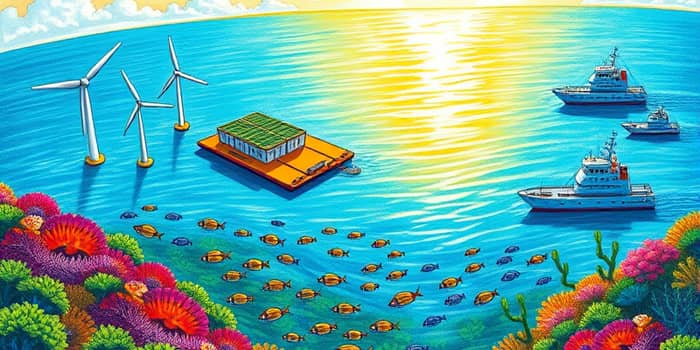
Our oceans are a source of food, jobs, and climate regulation. Yet investment in their future remains scarce. This article explores how strategic financing can unlock the full potential of the blue economy, aligning profit and preservation for a resilient tomorrow.
Across every continent, coastal communities depend on thriving marine ecosystems for livelihoods and security. As climate pressures intensify, the need to restore and sustain oceans has never been more urgent—or more promising as an investment frontier.
The World Bank defines the blue economy as sustainable use of ocean resources for economic growth. The European Commission expands this to include sectors like shipping, fishing, aquaculture, coastal tourism, marine energy, ocean technology, water management, blue biotechnology, ports, and observation systems.
Ocean-based economic activity is valued between USD 1.5 trillion and 2.5 trillion, making it comparable to the world’s 7th largest economy. Estimates vary by methodology, underscoring the need for consistent frameworks to capture the sector’s true scale.
Healthy seas support food for almost half the global population, harbor 80% of marine biodiversity, and cover over 70% of Earth’s surface. By integrating marine ecosystems into economic planning, governments and investors can foster resilience and shared prosperity.
Blue finance refers to funding for ocean-friendly activities. This term encompasses charitable grants, public financing, private equity, venture capital, blue bonds, blended finance, and carbon credits tied to nature-based solutions. To date, much capital has been philanthropic or small-scale, but momentum is building to unlock large private investments.
Blended finance structures are emerging as critical tools. They combine public grants or concessional loans with market-rate equity or debt, de-risking early-stage projects and catalyzing follow-on investments. Innovations in insurance, risk guarantees, and outcome-based contracts further align incentives for ocean stewardship.
As impact investors and ESG managers seek new frontiers, blue finance offers a compelling narrative that bridges environmental, social, and economic returns. The development of sustainable ocean finance principles by leading institutions provides a roadmap for capital deployment.
Despite its massive importance, the ocean remains underfunded relative to its importance. The World Economic Forum estimates USD 175 billion per year is needed to achieve SDG 14, “Life Below Water,” through 2030. Between 2015 and 2019, only USD 10 billion total was invested in ocean health.
Major financial institutions like Morgan Stanley highlight a funding gap of over USD 3 trillion in coming decades to protect marine ecosystems. Meanwhile, Ocean Panel research suggests that invest 2 trillion to 3.7 trillion dollars from 2020 to 2050 could generate 8.2T–22.8T in net benefits and deliver an exceptional ROI of 450%–615%.
Ocean investments drive multiple co-benefits: secure livelihoods for more than 3 billion people, safeguard coastal communities against storms, and capture carbon through blue carbon habitats. The economic case is clear: every dollar directed toward healthy oceans can yield at least five dollars in global benefits.
Investor interest in the blue economy is rapidly transitioning from niche to mainstream. The European Commission’s BlueInvest report 2026 notes 159 private funds active in the EU, with approximately €3 billion dedicated and another €11 billion with partial exposure to ocean sectors.
Key catalysts driving this shift include:
Major institutional investors—private equity, corporate players, and energy funds—are now evaluating the blue economy as a viable asset class. Improved measurement of ecosystem value and the emergence of labelled products like blue bonds have further bolstered confidence.
Investors seeking tangible impact and financial yield are focusing on several high-potential sectors:
While venture capital dominates early-stage financing, private equity and infrastructure investors are increasingly targeting mature projects in ports, shipping, and renewable energy.
Blue bonds, one of the most prominent instruments, have seen cumulative issuance reach nearly 9 billion USD. Governments and corporations issue these bonds to back projects meeting stringent environmental criteria, creating a trusted “ocean-friendly” label.
Blended finance platforms pool concessional and commercial capital to reduce risk for private investors. Development banks and philanthropic entities provide first-loss or guarantee mechanisms, while carbon credit markets monetize the climate benefits of restoration projects.
Sustainable ocean finance principles developed by the European Commission, WWF, WRI, and the EIB guide banks, insurers, and asset owners. These standards complement IFC Performance Standards and ensure that investments deliver social, environmental, and governance outcomes.
Challenges persist, including limited investor familiarity with marine projects, difficulties in standardizing outcome metrics, and a shortage of opportunities beyond pilot stages. Addressing these hurdles requires:
By pooling knowledge, resources, and risk, stakeholders can scale proven solutions and expand the pipeline of investable projects, unlocking larger pools of capital for ocean restoration and sustainable development.
The window to finance ocean health is open now. Emerging policies, maturing instruments, and clear evidence of returns create fertile ground for transformative investments. Investors who seize this moment can drive climate adaptation, economic growth, and ecosystem resilience.
Allocating capital through dedicated blue economy funds, sustainable infrastructure projects, and nature-based restoration initiatives offers a unique opportunity to achieve robust financial performance while securing the future of our planetary life support system.
With concerted action, we can mobilize the trillions needed to transition from underinvestment to abundance, harnessing the power of the blue economy to foster prosperity for people and planet alike.
Financing ocean health is more than an ESG checkbox—it is a strategic imperative and a compelling investment frontier. As the framework for blue finance solidifies, early movers will capture outsized returns and contribute to a legacy of resilience and renewal.
Together, we can chart a sustainable course where healthy oceans underpin economic vitality and environmental stewardship, ensuring that future generations inherit a thriving, life-sustaining planet.
References