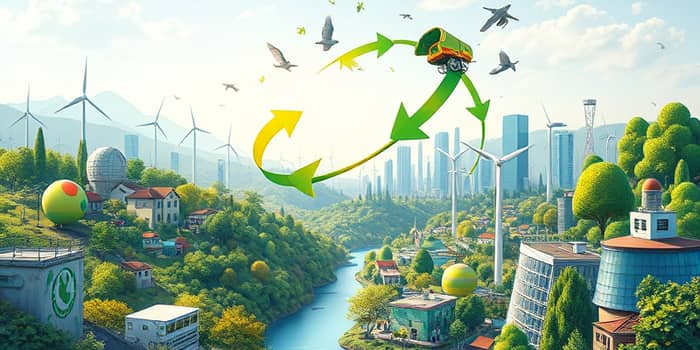
The global push to transition from a linear “take-make-waste” model to a regenerative circular economy is gaining momentum. With nearly US$164 billion invested in circular business models between 2018 and 2023, stakeholders across sectors now see unprecedented potential for resource efficiency and resilience.
Yet this momentum faces challenges. A 42 billion-dollar peak in 2021 slipped to 28 billion in 2023, and only 2% of tracked capital flows target high-impact design and production solutions. The moment calls for bold action, strategic redirection of finance, and collaborative innovation.
Since 2018, the world has witnessed an 87% surge in funding for models emphasizing reuse, repair, rental and recycling. Annual investments climbed from US$10 billion in 2018 to US$42 billion in 2021, before stabilizing at US$28 billion in 2023. Over 9,200 funding rounds closed in that period, each averaging US$37 million and attracting more than 3,000 investors globally.
This growth reflects growing investor appetite and an increasing business case. Firms like Temasek Holdings and Bain Capital joined public institutions such as the European Investment Bank to back pioneering circular ventures. Across asset classes, total circular economy financing now approaches USD 350 billion, and projections foresee a 23.5% compound annual growth rate from 2026 to 2035.
Despite impressive figures, a closer look reveals that high-impact design and production solutions capture just 4.7% of capital flows. The majority of funds still support conventional activities like car repair, resale marketplaces, and basic goods recycling.
To eliminate waste and pollution at source, an estimated US$15.4 trillion private and US$1.5 trillion public investment is needed by 2040 for plastics circularity alone. Yet tracking mechanisms lack transparency. Overall, circular investments represent just 2% of all tracked capital, and the global economy remains only 6.9% circular.
Resource productivity varies widely. The EU averages 2.7 € per kilogram, outperforming China in non-energy materials but trailing Japan. Meanwhile, global materials consumption stands at 100 billion metric tons per year (12.6 tons per capita), a figure that must fall below 5 tons per person by 2050 to ensure sustainability.
As of 2023, energy efficiency scores (out of 100) highlight regional leaders. Below is a snapshot of top performers:
France leads with top marks in industry and transportation, while Germany excels in national policies and buildings. China’s 26% improvement since 2018 underscores how targeted public transit upgrades and national energy targets drive rapid gains.
Companies adopting circular strategies report risk-adjusted returns and resilience. By unlocking new revenue streams—through product-as-a-service models, leasing, and repair services—they reduce exposure to volatile raw material markets and supply chain disruptions exacerbated by geopolitics and climate shocks.
Green bonds, ESG-focused equity funds, and municipal debt instruments now frequently include water recycling, waste-to-energy, and clean manufacturing projects. Executives increasingly view circularity not only as a sustainability imperative, but also as a core driver of long-term growth.
High-potential sectors remain underfunded, yet they promise paradigm-shifting impact. Companies and startups pioneering novel materials, chemical recycling, and reverse logistics are ready for scale:
In the UK, multi-million-dollar circular facilities for closed-loop plastics and precious metals extraction from e-waste are emerging. Innovations in AI-driven waste management, reverse logistics platforms, and waste-to-resale marketplaces signal a new era of resource efficiency.
To unlock the full potential of a circular future, stakeholders must coordinate action:
The trajectory of global resource efficiency will define economic, environmental, and social well-being for decades. While progress to date is encouraging, the underinvestment in transformative solutions underscores an urgent need for redirection.
By aligning capital with the most impactful circular strategies, fostering policy coherence, and championing breakthrough innovations, we can craft a future where economic prosperity and planetary health reinforce each other. The time to act is now—let us seize this moment to build a resilient, regenerative world.
References