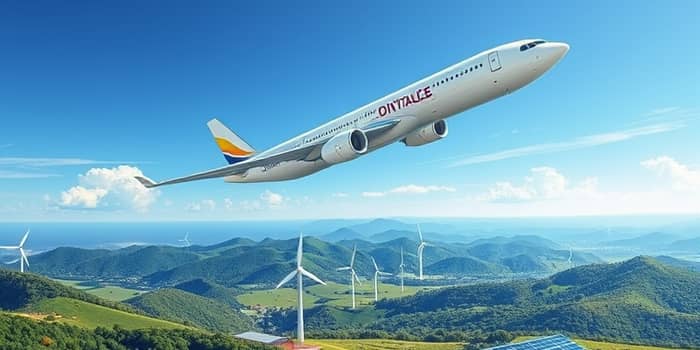
As the world grapples with climate change, the aviation sector faces both scrutiny and opportunity. With billions of passengers and tonnes of cargo transported annually, the industry’s footprint is significant. Sustainable aviation offers a chance to transform air travel from a growing climate challenge into a beacon of environmental innovation.
In this article, we explore the motivations, technologies, policies, and economics driving the journey toward net-zero emissions in aviation. By understanding the stakes and the solutions, stakeholders—from airlines to travelers—can play a part in creating a cleaner future for flight.
Aviation contributes substantially to global greenhouse gas emissions. According to IPCC and IEA data, the sector accounts for over 2% of all emissions, representing 12% of transport sector emissions worldwide. International flights produce about 60% of that CO₂, with the remainder coming from domestic routes.
Short-haul travel poses its own challenges. Eurocontrol’s 2021 study found that flights under 1,500 kilometers generate roughly 25% of global aviation CO₂. Meanwhile, U.S. carriers emit around 2% of national carbon, yet have pledged net-zero emissions by 2050 under Airlines for America’s commitment.
Environmental impacts extend beyond CO₂. Nitrogen oxides, contrails, noise pollution, local air quality, and waste management are all part of the sustainability equation. Airports and airlines must also address biodiversity protection, community welfare, and fair labor practices to ensure a truly responsible approach.
The International Air Transport Association (IATA) and the United Nations’ ICAO have set ambitious climate goals. IATA’s roadmap aims for net-zero CO₂ by 2050, achieved through a mix of strategies:
ICAO’s Long-Term Aspirational Goal (LTAG) aligns with the Paris Agreement, targeting carbon-neutral international flights by mid-century. Its CORSIA program already mandates carbon offsetting for growth beyond 2020 levels. In 2023, a 5% reduction in CO₂ intensity by 2030 was endorsed by over 190 states, driven largely by SAF deployment.
National plans add momentum. The U.S. Sustainable Aviation Fuel Grand Challenge envisions 3 billion gallons of SAF by 2030, scaling to 35 billion gallons by 2050, with at least 50% lifecycle emissions reduction. The European Union mandates SAF blending quotas from 2025 and tightens emissions trading to accelerate adoption.
SAF is a cornerstone of aviation’s decarbonization. These drop-in fuels, derived from renewable or waste feedstocks, can lower lifecycle CO₂ by up to 80% compared to conventional jet fuel. Because SAF is compatible with existing fuel infrastructure, it can blend with Jet A and Jet A-1 at ratios from 10% to 50%, depending on certification.
Feedstock options are diverse:
Stringent sustainability criteria ensure feedstocks avoid competition with food crops, deforestation, or soil degradation. By leveraging waste streams and renewable energy, SAF promises transformative emissions reductions across global fleets.
Current SAF production remains nascent. In the United States, total jet fuel demand reached 1.6 million barrels per day in 2023, yet SAF capacity stood at only 2,000 b/d, supplied by two plants in California and Montana. If all announced facilities launch in 2024, capacity could surge to nearly 30,000 b/d.
Global demand projections are equally ambitious. The World Economic Forum estimates SAF needs of 17 million tonnes by 2030—4–5% of jet fuel demand—requiring an additional 5.8 million tonnes of capacity. Meeting this target hinges on $19–45 billion in investment by 2026 to fund final investment decisions and scaling projects.
SAF production costs currently exceed fossil jet fuel by over twofold, posing a significant barrier. Incentives such as the U.S. Renewable Fuel Standard, Low Carbon Fuel Standard credits, and the European SAF blending mandate help narrow this gap by subsidizing production and rewarding low-carbon pathways.
Emerging carbon markets and sustainable finance instruments offer additional support. Airlines and investors can secure green loans or issue sustainability bonds tied to SAF volumes. Corporations with ambitious net-zero targets may contract SAF offtake agreements, providing revenue certainty for producers.
Ultimately, scaling SAF reduces unit costs through learning curves and economies of scale. As production ramps, investors can expect stronger returns and airlines stand to benefit from reduced carbon levies and improved public perception.
Despite progress, hurdles remain. Feedstock supply chains must expand without driving land-use conflicts. Regulatory frameworks need harmonization across borders to facilitate SAF trade. Infrastructure upgrades at airports—including storage tanks and blending systems—require capital and coordination.
Financial risks include uncertain carbon prices and evolving sustainability criteria. Addressing these risks demands multi-stakeholder collaboration:
Sustainable aviation extends beyond fuel. Next-generation aircraft—electric, hydrogen-powered, and hybrid designs—promise further efficiency. Advanced air traffic management and optimized routing can shave minutes off flights, trimming emissions and delays.
Moreover, community engagement programs ensure airport expansions respect local ecosystems and social needs. Integrating renewable energy in ground operations, reducing single-use plastics onboard, and innovating in waste recycling all contribute to a holistic sustainability agenda.
The path to net-zero aviation is complex but navigable. With bold commitments, strategic investments in SAF, and collaborative policy frameworks, the industry can align growth with planetary boundaries. By embracing innovation and responsibility, aviation can emerge as a powerful driver of sustainable development.
Every stakeholder—governments, airlines, investors, and passengers—has a role in this journey. Together, we can ensure that future generations inherit skies that are not only busy with flight, but also clear of excess carbon, noise, and environmental harm. The time to act is now, as we chart a course toward clean, responsible air travel and a truly sustainable future.
References