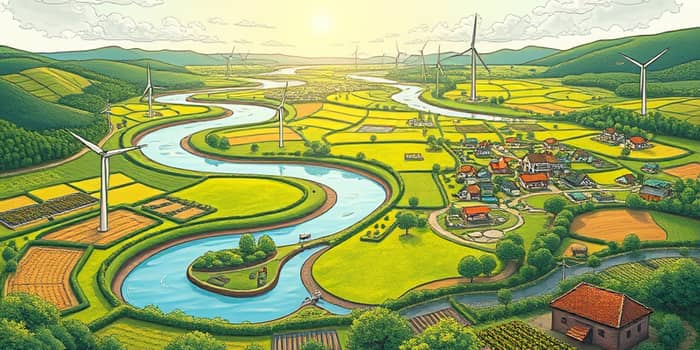
In a world facing ecological crises and social inequities, a new approach to finance emerges—one that aligns capital with living systems, empowering communities to restore lands, waters, and cultures. This is the vision of hyperlocal regenerative investment, where money flows like water through landscapes, fostering abundance and resilience.
Hyperlocal Regenerative Investment refers to place-based financing mechanisms that channel capital into regenerative economies at the bioregional scale, rooted in soils, watersheds, and cultural ties rather than arbitrary political borders. This approach contrasts sharply with extractive finance, which prioritizes short-term profits over ecological and social health.
At its core lies the principle that finance must flow like water—nurturing long-term ecological, social, and economic regeneration instead of extracting value. By grounding investments in the scale of life itself, communities can co-create portfolios of synergistic projects that revitalize landscapes, rebuild local economies, and strengthen social bonds.
Several key vehicles bring this vision to life. Each blends different types of capital—philanthropic, public, private, and community—under local governance to support integrated, landscape-level projects.
BFFs function as the connective tissue between global capital and on-the-ground regenerators. They operate with place-based governance, ensuring that those closest to the land decide how resources are allocated. A BFF typically features the following:
Variants of BFFs include bioregional trusts, regenerative venture studios, and community-owned banks, each tailored to local contexts. These structures build adaptive community governance, empowering residents to steward resources for future generations.
Across the globe, pilot initiatives demonstrate the power of hyperlocal regenerative financing:
These examples reveal a constellation of benefits: enhanced soil health, restored watersheds, thriving biodiversity, and resilient rural livelihoods—all achievable alongside attractive financial returns.
The global market for regenerative landscapes is vast. Analysts estimate a $310 billion opportunity across 30 priority regions, with potential IRRs of 15–30%. Yet only a fraction of climate finance currently reaches sustainable agriculture and ecosystem restoration.
By leveraging catalytic capital to de-risk projects—through grants, concessional debt, and off-take agreements—hyperlocal finance can mobilize both public and private pools of capital. In Brazil’s LAB program, $100 million committed today aims to scale to $1 billion by 2030, unlocking $5 billion in total mobilization.
Scaling regenerative finance requires supportive frameworks and technologies:
Cross-bioregion networks and learning ecosystems further enhance capacity, enabling communities to share insights and co-develop funding web models akin to natural networks.
Hyperlocal regenerative investment represents more than a financial innovation—it is a paradigm shift. It transforms capital from a tool of extraction into an instrument for restoration, weaving prosperity and resilience into the fabric of every bioregion.
By aligning finance with the rhythms of life, communities can heal degraded lands, revitalize waterways, and fortify social cohesion. This approach not only yields robust returns but also ensures that future generations inherit landscapes teeming with diversity and vitality.
As we envision a global tapestry of Bioregional Financing Facilities and community banks, we are reminded that true wealth resides in the health of our ecosystems and the strength of our relationships. Now is the time to rewild our money, anchor investments in the places we call home, and catalyze a regenerative renaissance across Earth’s bioregions.
References