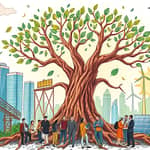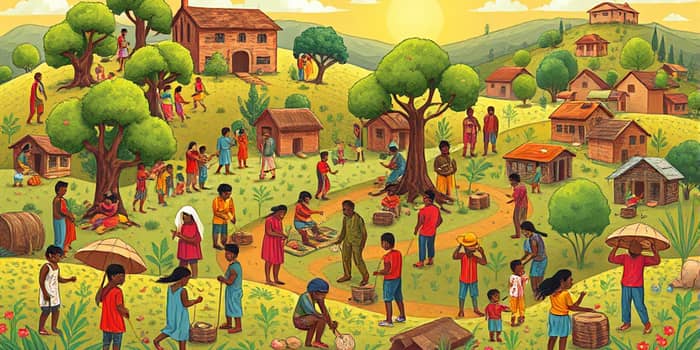
Across the globe, communities are awakening to an economy where capital no longer extracts and exhausts, but instead heals and regenerates. The restorative economy reimagines financial flows as tools for rebuilding ecosystems, mending social fabrics, and empowering those long marginalized by extractive systems. It is a bold invitation to place community-led decision-making processes at the center of wealth creation.
This movement challenges us to see money as more than profit—it becomes an instrument of care, equity, and shared abundance. As we embrace this new paradigm, we discover that the true measure of success lies in restored relationships between people and the planet.
Traditional capitalism often values accumulation above all else, thriving on scarcity and competition. In contrast, the restorative economy envisions capital as a healing force that nurtures interconnected systems. It is a deliberate paradigm shift from extractive practices to models that honor ecological boundaries and social equity.
At its core, this approach invites impacted communities to own and manage land, assets, and financial tools. By building frameworks such as community land trusts, cooperatives, and multi-member LLCs, we re-center power in the hands of those most affected by historical and ongoing injustices.
Drawing from diverse global experiments, several guiding principles illuminate the path forward. These principles form the backbone of initiatives that heal both people and planet:
Aligned with frameworks like Doughnut Economics and regenerative design, these principles reject linear extraction. Instead, they call for circular flows of resources, honoring both human dignity and planetary limits.
Communities pioneering restorative economy projects employ a variety of strategies, from targeted funding to collaborative land stewardship. Organizations like Kataly Foundation and Restore Oakland exemplify how catalytic capital can seed community-owned infrastructure that generates lasting wealth.
Key practices include:
These methods are reinforced by technical assistance, policy advocacy, and cross-sector collaboration. In West Kalimantan, Indonesia, the Kabupaten Lestari model demonstrates how balancing basic needs with ecological thresholds produces both prosperity and ecosystem rejuvenation.
At its heart, the restorative economy dreams of an abundant future where every person thrives. It replaces zero-sum competition with an ethic of reciprocity and collective flourishing. By centering care and relationships, this vision rejects the notion that scarcity must define our lives.
Restorative initiatives across the world—from urban green spaces in Oakland to climate-resilient microgrids in marginalized neighborhoods—showcase the transformative potential when communities wield capital to uplift themselves. These examples remind us that true abundance arises when power is shared, not hoarded.
Whether through financial contributions, grassroots organizing, or simply educating ourselves and others, each action brings us closer to an economy that cares. By embedding justice and regeneration in every investment, we collectively rewrite the rules of prosperity.
The restorative economy is not a distant utopia—it is unfolding here and now, wherever communities reclaim capital for healing and growth. As we amplify these efforts, we nurture both people and planet, forging a legacy of shared well-being for generations to come.
References