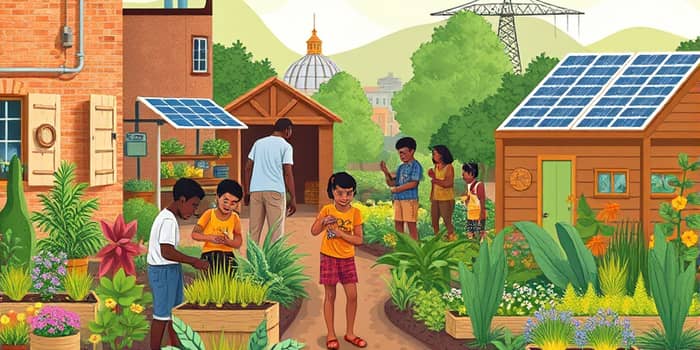
Across the globe, communities are rediscovering and reclaiming shared assets—from urban gardens to open-source software. Financing these commons requires a fundamental shift away from profit-driven capital towards structures that nurture equity, ecological health, and long-term stewardship. This article explores how to design and deploy financial mechanisms that sustain shared resources, support democratic governance, and create a regenerative cycle of collective flourishing.
Over recent years, a growing number of practitioners, researchers, and policymakers have recognized that neither markets nor states alone can steward the complex web of shared assets we all depend on. From climate-vulnerable watersheds to digital platforms underpinning critical research, the need for financing models that honor collective ownership and regenerative use has never been more urgent.
The term “commons” refers to resources collectively managed for mutual benefit. These can include natural ecosystems like forests and fisheries, urban spaces such as community land trusts and maker spaces, or digital platforms like open-source software and shared research databases. Far from passive assets, commons thrive through “commoning”—the social practice of co-creation, democratic decision-making among community members, and ongoing stewardship.
By definition, a commons is neither purely private nor entirely public. It exists alongside market and state institutions, governed by local norms, transparent rules, and inclusive processes. Commoning ensures that users, workers, and stakeholders share responsibility, voice, and accountability over resource use.
Financing the commons is not the same as financing a private corporation. Traditional market finance prioritizes risk-adjusted financial returns to investors, measured over relatively short time horizons. Commons finance, by contrast, aims to sustain and regenerate shared resources, foster social cohesion, and protect ecological health across generations.
In conventional models, ownership is hierarchical and profit-driven. Commons structures—cooperatives, mutuals, trusts, and associations—are democratically governed financial structures and accountable to their communities. This shift in purpose and ownership leads to different value creation: commons generate systemic benefits like resilient local economies, stronger social fabrics, and biodiversity conservation, much of which is not captured in market metrics.
At the heart of commons-oriented investment is non-extractive finance: capital that supports communities without extracting undue value. Seed Commons, a pioneer in this field, articulates a simple baseline: cost of capital should never exceed the wealth generated by the project. They often go further, capping the cost of capital to 50% of the surplus generated, ensuring at least half of all profit remains within the community enterprise.
These structural safeguards mean that if a project underperforms, investors receive nothing. This design principle anchors finance in community needs rather than speculative returns. As Seed Commons explains, their goal is forging financial infrastructure to keep resources flowing, maintaining the vitality of shared assets through multiple economic cycles.
Building robust financial ecosystems for the commons requires a multidimensional approach:
Seed Commons describes this model as a regenerative cycle of mutual flourishing. Each successful project cultivates social capital and financial resources that uplift subsequent initiatives, creating a self-sustaining ecosystem of shared prosperity.
Several pioneering organizations demonstrate how these principles work in practice:
Participatory governance not only embeds equity; it also mitigates risk. When borrowers have a stake in decisions, they are more committed to the long-term health of the enterprise. Decision rules such as one-member-one-vote and rotating representation ensure that power remains distributed, fostering trust and accountability.
As climate change, inequality, and social fragmentation intensify, financing the commons offers a path toward equitable resilience. By embedding community voice in financial decisions and reclaiming surplus for collective benefit, we can nurture the ecosystems—social, economic, and ecological—that underpin human well-being.
Practically, stakeholders can begin by:
Governments, institutions, and investors must also recognize systemic value beyond narrow financial metrics. When capital is capital subordinated to community needs, it becomes a tool for empowerment rather than extraction.
Individual impact investors can also seek out funds that follow these principles, community banks can develop credit products aligned with non-extractive terms, and national governments can partner with cooperative banks to scale these models at a national level.
The road ahead requires experimentation, trust-building, and a willingness to challenge entrenched assumptions about profit and growth. But as more success stories emerge, the blueprint for financing the commons becomes clearer. Together, we can redefine prosperity to include the health of our communities, ecosystems, and future generations.
References