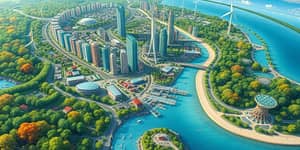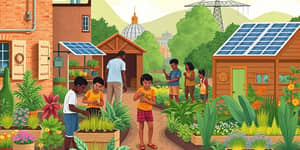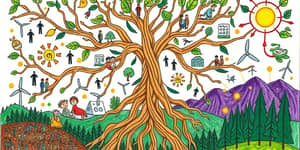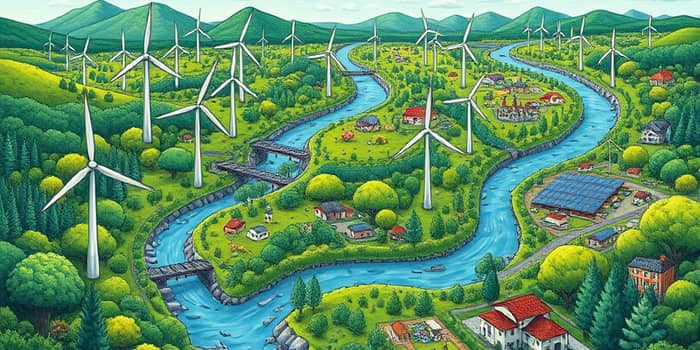
As global uncertainties mount, the convergence of ecology and economy offers a path toward shared prosperity.
Natural capital must be recognized as vital infrastructure alongside roads, power grids, and digital networks. When ecosystems degrade, we incur financial liabilities; when we restore them, we build long-term assets that deliver enduring value.
Far from being an abstract ideal, this shift unlocks a triple dividend of resilience: avoided losses, economic growth, and social and environmental well-being. By treating wetlands, forests, and coastal systems as core assets, we elevate conservation to the same level of priority as highways and hospitals.
Today, one in five countries stands on the brink of natural system collapse. Between 20% and 40% of the world’s land is degraded, while only 3% of ecosystems remain ecologically intact. The stakes could not be higher.
Yet investment in nature yields remarkable returns. Annual economic gains from strategic ecological policies could range from $100 billion to $350 billion, with potential upside of $25–125 billion more in GDP by 2030. Factoring in carbon sequestration at $185 per ton adds another $10–150 billion of value per policy.
Advanced Earth-economy models reveal that a suite of nature-focused policies can deliver GDP gains of $100–200 billion per year by 2030 compared to business as usual. Payments for ecosystem services, agricultural research and development, and combined carbon-rich land protections offer the largest economic and environmental payoffs.
Under ambitious climate scenarios, investment in low-emissions technology and energy efficiency also drives GDP growth. For example, building energy upgrades in Kazakhstan could unlock over $70 billion in savings by 2060, while similar measures in Bangladesh’s textile sector cut consumption by 30% and boost productivity by 10–15%.
Across the globe, visionaries are adopting natural capital accounting to guide policy and finance. In China, Gross Ecosystem Product (GEP) now parallels GDP, steering restoration and compensation programs. India’s Uttarakhand leads the way with state-level GEP adoption, and Gabon integrates ecosystem valuations into sovereign finance planning.
Between the 1930s and 1980s, New Zealand invested $3.6 billion in flood protection, generating $13 billion in annual benefits—a 3.6× return that unlocked new agricultural land and thousands of jobs.
To mobilize capital at scale, we must rewire financial systems and embed nature into every decision. Key strategies include:
Fifteen proven interventions—from urban heat mitigation to digital water management—deliver measurable socioeconomic returns. Enablers such as reduced insurance premiums, low-interest green loans, and streamlined permitting can accelerate uptake.
Traditional GDP overlooks critical dimensions of well-being and ecological stability. By measuring welfare through consumer-equivalent variation and integrating biodiversity metrics, policymakers can capture the full value of resilience investments.
For instance, designing marine reserves based on ecosystem stability—rather than just biomass—ensures more robust fisheries and livelihoods. Accounting for variance in species abundances leads to reserve networks that both safeguard biodiversity and support coastal economies.
Ecological investments unlock:
Moving beyond aid dependency, nations must embrace proactive investment in natural capital as a foundation for security and stability. Framing resilience as a catalyst for jobs, confidence, and sustainable growth transforms perceived burdens into compelling opportunities.
To deliver on this promise, stakeholders across government, finance, and civil society must unite behind a unified narrative that makes nature visible and actionable. Standardized valuation methods, remote sensing, AI-driven modeling, and supply chain traceability can provide the data needed to drive bold decisions.
Now is the moment to:
By weaving ecological investment into the fabric of economic planning, we can unlock unprecedented returns—financial, social, and environmental—and ensure a resilient, flourishing future for all.
References