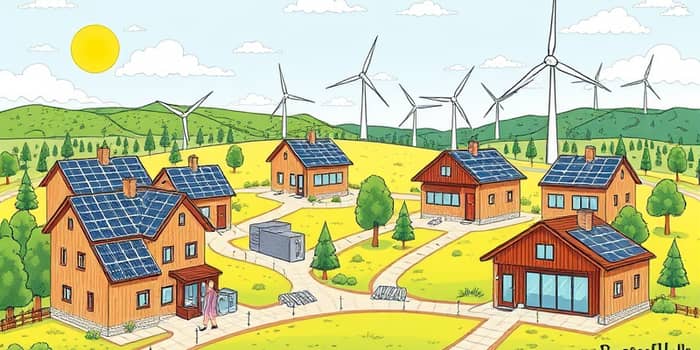
Across the globe, communities and critical facilities are rethinking their relationship with electricity. From remote islands to urban campuses, the rise of renewable microgrids is reshaping how we generate, distribute, and safeguard power. These systems marry local resilience with broader environmental and economic gains, proving that group of interconnected loads and distributed energy resources can drive transformative change.
A microgrid is a small-scale, localized power grid that can operate both connected to the main grid and autonomously in island mode. Within clearly defined electrical boundaries, it combines multiple energy sources and loads, acting as a single controllable entity to maintain stable voltage and frequency.
Key technical elements include advanced controllers, energy management systems, and often battery storage. These components ensure seamless transitions between grid-connected and islanded operation, keeping power flowing when it matters most.
Several converging trends are accelerating microgrid adoption. Extreme weather and cyber threats demand energy resilience during outages and disasters. Meanwhile, plummeting costs for solar and wind make local renewable generation economically attractive. Governments and investors recognize the decarbonization potential of these systems, driving policy incentives and funding.
For communities cut off by geography or overwhelmed by demand spikes, microgrids represent not just backup power but a pathway to energy sovereignty and environmental stewardship.
Resilience and Reliability: When the main grid fails, microgrids can disconnect at the point of common coupling and continue serving critical loads. Hospitals, military bases, water treatment facilities, and data centers maintain continuity of operations without interruption, shielding people and infrastructure from blackouts.
Renewable Integration: Incorporating solar PV, wind turbines, biomass, and fuel cells becomes feasible at a localized scale. Battery storage smooths variability, allowing excess generation to be stored for later use or, in some cases, exported to the main grid.
Lower Emissions and Environmental Benefits: By shifting consumption from centralized fossil generators to local renewables, microgrids can achieve lower greenhouse gas emissions and pollutants. They also cut transmission losses, since power is produced closer to where it’s used.
Cost Savings and Efficiency: Microgrids shave peak demand, reduce line losses, and avoid or defer costly utility upgrades. Many operators benefit from lower electricity bills, demand-charge management, and even revenue from ancillary services.
Local Economic Development: Constructing and operating microgrids creates skilled jobs in engineering, installation, and maintenance. Local businesses thrive on reliable power, and communities gain energy independence that attracts new investment.
Grid Support: Connected microgrids can provide frequency regulation, voltage support, and congestion relief to utilities. These services defer capital projects and improve overall system efficiency.
Islanding and Point of Common Coupling: A microgrid’s ability to island ensures uninterrupted service. The point of common coupling is the switchgear interface that separates and reconnects the microgrid from the main utility.
Advanced Control Systems: Energy management software monitors generation, load, and storage in real time. It optimizes dispatch, prioritizing renewables while ensuring stability.
Voltage and Frequency Stability: Power electronics and inverter controls maintain quality within tight tolerances. Sensitive equipment—like medical devices and servers—runs smoothly even during transitions.
Battery Storage and Demand Response: Storage smooths renewable variability and provides spinning reserve. Demand response programs shift or shed load to balance supply and demand, enhancing efficiency and lowering costs.
Microgrid deployment is accelerating worldwide. In the United States, less than 0.3% of electricity currently comes from microgrids, yet capacity has grown almost 11% over the past four years. As of early 2023, 692 microgrids totaling nearly 4.4 GW were operational, with 212 new projects adding over 419 MW in that period.
Globally, estimates vary from USD 43 billion by 2025 to over USD 95 billion by 2030, driven by renewable integration, storage technology advances, and resilience demand. Policies in states like California, New York, Massachusetts, and beyond provide grants and incentives, fueling innovation and deployment.
Renewable microgrids represent a paradigm shift in how we perceive electricity. No longer must power be delivered solely from distant, centralized plants. Instead, communities can harness local solar, wind, and storage to meet their own needs while supporting broader decarbonization goals. This model empowers stakeholders from remote islanders to urban campus planners.
As technology costs continue to fall and control systems become more sophisticated, microgrids will move further into the mainstream. Businesses and municipalities that invest now gain diversifies backup power sources for reliability while lowering carbon footprints and fostering local jobs.
The journey toward a resilient, low-carbon energy future is underway. By embracing renewable microgrids, we unlock both local power and global returns—ensuring communities thrive, economies grow, and our planet benefits.
References