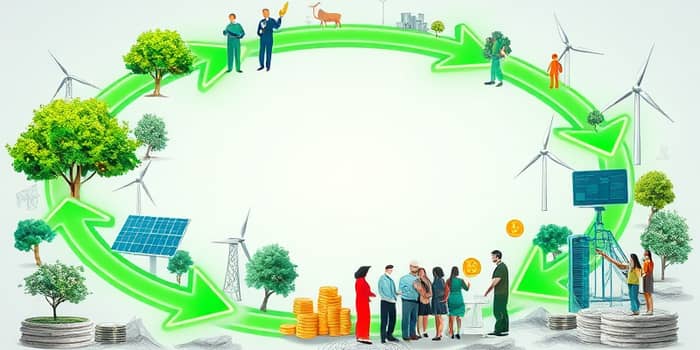
In a world seeking resilience and sustainability, circular finance offers a beacon of hope. By channeling capital into projects that embrace a regenerative and restorative economic system, investors can unlock value, reduce waste, and foster long-term prosperity.
This article explores how circular finance transforms the traditional investment landscape, driving innovative business models and delivering environmental and social benefits.
The linear economy follows a take–make–dispose model that extracts resources, manufactures products, and ultimately discards waste. In contrast, the circular economy aims to maintain the value of products by extending lifecycles, designing out waste, and regenerating natural systems.
Key R-strategies guide this transition:
These approaches decouple growth from resource consumption, lower greenhouse gas emissions, and create more resilient supply chains.
Circular finance encompasses any financial service or product that supports projects aligned with circular economy principles. By integrating these principles into capital allocation, risk management, and underwriting, financial institutions can play a pivotal role in the systemic shift to a circular model.
As a critical subset of sustainable finance, circular investments aim to diversify portfolios and reduce exposure to volatile commodity prices. They also align with major policy frameworks such as the EU Taxonomy and green bond standards, enhancing transparency and credibility.
Investors can choose from a range of circular finance instruments. Each leverages different mechanisms to fund projects that prolong asset lifecycles and support resource efficiency.
These products offer enhanced risk-adjusted returns by mitigating exposure to resource scarcity and regulatory changes. They also create opportunities for innovation and competitive advantage.
Circular finance can drive transformation across diverse sectors. Notable areas include:
For example, a European electronics firm financed via a circular bond improved supply chain resilience by sourcing remanufactured components. A green loan enabled a construction cooperative to adopt prefabricated building modules, cutting waste by 40% and creating skilled jobs in modular assembly.
Despite clear benefits, circular finance faces challenges in scaling:
Practical solutions include:
1. Developing harmonized reporting frameworks to ensure consistent metrics for resource savings, recycled content, and emissions avoided.
2. Creating blended finance structures that combine public guarantees with private capital to de-risk early-stage circular ventures.
3. Promoting collaborative platforms where investors, entrepreneurs, and policymakers co-develop bankable circular projects.
Global guidelines are emerging to unify standards for circular economy finance:
- The EU Circular Economy Finance Guidelines outline a four-component framework covering use of proceeds, project evaluation, management, and reporting to ensure integrity in debt and equity markets.
- The IFC’s Harmonized Circular Economy Finance Guidelines provide a sector-agnostic tool for identifying eligible activities, quantifying investment flows, and facilitating tracking and reporting.
- UNEP FI and the Global Alliance on Circular Economy and Resource Efficiency emphasize aligning circular finance with climate, biodiversity, and social safeguards, echoing principles of “do no significant harm” and “substantial contribution.”
Evidence suggests that investments in circular economy projects can deliver superior risk-adjusted returns over the long term. By reducing dependence on virgin materials, circular portfolios are better insulated from price shocks and stranded asset risks.
Moreover, these investments support corporate climate commitments and align with policy incentives such as green taxonomies and sustainability disclosure mandates. As regulatory frameworks mature, the bankability of circular projects will further improve, unlocking additional capital.
Circular finance offers a transformative pathway for investors seeking both financial performance and positive impact. By investing in a loop of value, capital markets can drive innovation, resilience, and regeneration across economies and ecosystems.
As best practices, harmonized guidelines, and proof points proliferate, the transition to a circular economy will accelerate. For investors, embracing circular finance today is not only a strategic imperative but also an opportunity to shape a sustainable and inclusive future.
References