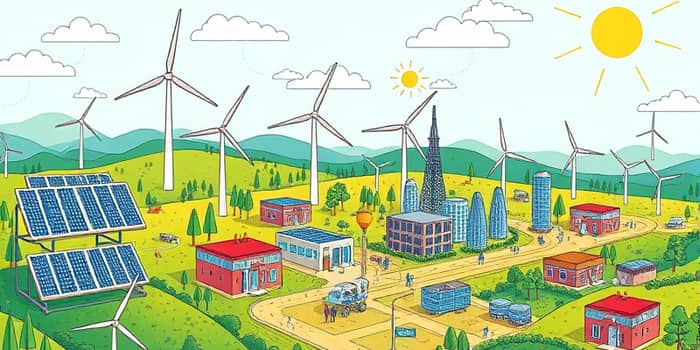
In an era defined by climate urgency and technological breakthroughs, securing capital for green innovation has never been more critical. Venture capital and growth funds around the globe are channeling unprecedented resources into clean energy and sustainability ventures.
From solar PV advancements to AI-driven energy management, the landscape is bursting with opportunity. Investors and entrepreneurs alike must understand the evolving funding mechanisms, strategic partnerships, and emerging trends that will shape the next decade of climate action.
In 2025, $29 billion of US venture capital flowed into climate tech, marking the third highest on record. Worldwide, investment swelled to $40.5 billion, underscoring a global commitment to sustainable solutions. Clean energy funding itself grew 31% to $14.4 billion, a three-year high that signals strong market confidence.
Analysts predict that in 2026, cleantech investments will surpass fossil fuels, a milestone that reflects shifting priorities and accelerating demand for renewable alternatives. Solar PV continues to lead the charge, supported by dramatic cost reductions and increasing capacity.
Several strategic funds and startups closed landmark financing in late 2025 and early 2026. The following table highlights the top five capital raises, showcasing the diversity of focus areas and the scale of investor commitment.
Traditional equity financing is no longer the sole avenue for scaling green technology. Diverse models now enable projects to access capital while balancing risk and impact.
Investment dollars are flowing into a spectrum of technologies, each offering unique pathways to reduce emissions, enhance efficiency, and drive sustainability.
These sectors represent the critical components of a low-carbon future, with each innovation offering scalable impact and attractive investment opportunities.
Building a robust climate tech ecosystem requires cooperation across industries, academia, and government. Federal Laboratory Partnership Agreements and non-profit foundations are driving translational R&D, while international initiatives foster cross-border innovation.
Key programs include the NIST “Unleashing American Innovation” initiative, designed to maximize transfer of federal research to the private sector, and COP28’s TechSprint, which leverages AI, blockchain, and IoT to advance sustainable finance solutions across 31 countries.
Major investors such as Breakthrough Energy Coalition, J.P. Morgan, and BBVA CIB offer tailored funding and advisory services. By aligning corporate, institutional, and governmental priorities, these collaborations create a multiplier effect that accelerates deployment of breakthrough technologies.
Platforms such as the Clean Energy Business Network and UNLEASH Innovation Lab cultivate communities of young entrepreneurs, providing mentorship, databases of funding opportunities, and hands-on challenges that accelerate idea-to-market pipelines.
Despite strong momentum, the climate tech sector faces headwinds. More than 50 federal actions since 2024 have introduced policy uncertainty, and 52% of companies report challenges in accessing grants and subsidies. Proposed cuts to IIJA funding and EPA research grants threaten to slow innovation.
However, these obstacles also present opportunities. Investors are shifting to a “bigger checks, fewer bets” approach, focusing on companies with proven long-term assurance. This trend favors startups that demonstrate clear scalability and technical maturity.
By engaging with federal programs, leveraging blended finance models, and building strategic partnerships, innovators can navigate regulatory complexities and maintain momentum. Transparency, robust data collection, and impact measurement will be essential to secure support and build stakeholder confidence.
Economic impact studies and transparent reporting protocols can further strengthen investor trust. By setting clear benchmarks for technology transfer and environmental performance, startups can differentiate themselves in a crowded market and unlock larger funding rounds.
The next wave of green technology will be defined by bold vision, collaborative networks, and creative financing. Whether you are a venture capitalist, a project developer, or a policy advocate, there are concrete steps you can take today to drive progress:
Additionally, consider leveraging crowdfunding to validate market demand and build grassroots support. Engaging directly with community stakeholders not only raises funds but also fosters a network of champions who will advocate for your success.
By embracing these approaches, stakeholders can unlock new capital streams, accelerate commercialization, and ensure that the coming decade delivers transformational change for people and the planet.
The clock is ticking on climate action, but the alignment of technology, investment, and policy offers unprecedented promise. Let us commit to funding the innovations that will power a sustainable future and leave a lasting legacy for generations to come.
References