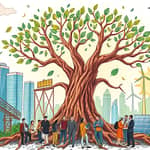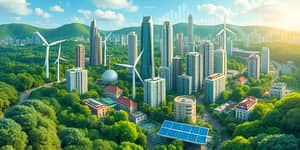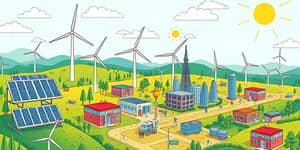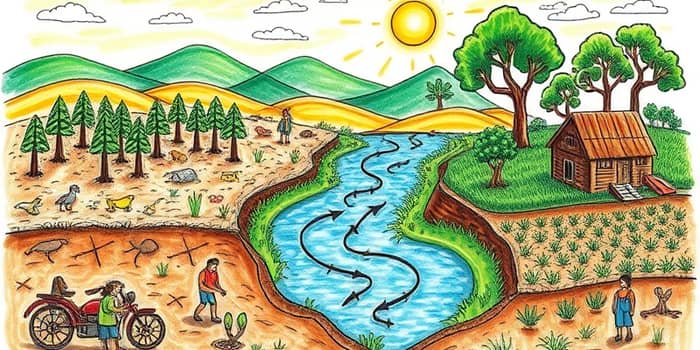
Our planet is sending urgent signals that the legacy of unchecked extraction has reached its limits. For two centuries, industrial growth relied on taking more than nature could replenish. Today, the degradation of land, water, and communities demands a paradigm shift. This article explores how investing in a living economy that harmonizes with life can transform depletion into renewal, creating resilient systems that endure for generations.
Extraction shaped modern society: coal, oil, minerals, timber and even data were harvested without accounting for the costs borne by ecosystems and people. Financial markets amassed profits while landscapes turned to dust and communities were uprooted. As one critic put it, we ended up with “wealth on spreadsheets and poverty on the ground”, a stark illustration of how disconnected our economy became from natural limits.
The consequences are profound. Soil erosion diminishes agricultural yields, freshwater reserves dwindle, and biodiversity collapses. Meanwhile, climate change acts as a delayed invoice for past resource abuse. A perpetually growing economy deployed against a finite biosphere is a recipe for systemic failure. This tension demands that investors, policymakers, and citizens reconceive value beyond short-term returns.
Regenerative finance offers a radical alternative to extractive capital. Rather than pricing nature solely for what can be removed, it honors what ecosystems continuously provide: clean water, fertile soils, carbon capture, and biodiversity. This model seeks intergenerational value creation instead of quarter-by-quarter gains, aligning economic incentives with the clock of nature.
Three tectonic shifts define this approach:
Under this lens, investors channel resources into projects that build abundance. For example, financing agroecological transitions not only yields crops but enhances soil health, sequesters carbon, and nurtures community well-being. Such projects cultivate resilience, enabling ecosystems to rebound from shocks and society to thrive within ecological boundaries.
At the heart of regeneration lies resourcefulness: the art of doing more with less by circulating, reusing, and regenerating assets. Resourceful systems mimic natural cycles, where waste from one process becomes input for another. This circular flow of materials and energy creates a living economy that stands in stark contrast to linear extraction models.
Communities that embrace resourcefulness innovate locally: artisans repurpose industrial by-products, urban neighborhoods establish repair cafés, and farmers implement agroforestry to diversify yields. By valuing social and institutional ingenuity, resourcefulness transforms externalities—once invisible social or ecological costs—into recognized revenue streams. Projects that pay land stewards for carbon sequestration or watershed protection exemplify this shift, internalizing benefits that were historically neglected.
Achieving regeneration requires coordinated action. Investors, policymakers, communities, and entrepreneurs can pursue multiple strategies to foster resourcefulness and resilience:
At the grassroots level, community-led cooperatives and commons initiatives exemplify resourcefulness in action. By pooling resources, sharing knowledge, and rotating leadership, they create robust networks that adapt to change and distribute benefits equitably. These models also serve as living laboratories, demonstrating scalable solutions for larger systems.
Traditional financial metrics, focused on short-term earnings per share, are inadequate for assessing regenerative initiatives. Instead, success must be gauged through a blend of ecological, social, and economic indicators. Key metrics include:
By embedding these measures into investment frameworks and reporting standards, stakeholders can track progress toward a living economy. This approach ensures that capital flows reward true regeneration, not just superficial improvements.
The transition from depletion to regeneration is not a gradual tweak but a fundamental reordering of priorities. We must move from an extractive growth model that pits economic advancement against planetary health to a resourceful paradigm where both flourish. This journey demands courage, creativity, and collaboration across sectors and scales.
Every investor, policymaker, entrepreneur, and citizen has a role to play in this transformation. By championing long-term intergenerational value creation and aligning incentives with natural cycles, we can turn the tide on resource exhaustion. In doing so, we sow seeds today that will grow into thriving forests, resilient communities, and a sustainable future for all.
References