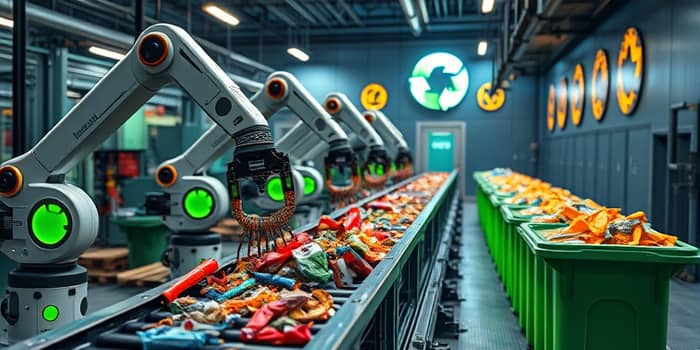
The global waste challenge demands innovation. Today, artificial intelligence is not just an experimental add-on but a fundamental driver of a circular economy through smart automation. By transforming labor-intensive processes into automated, accurate systems, AI offers a pathway to turn our trash into valuable resources, reduce environmental impact, and boost operational efficiency.
For decades, waste sorting relied on manual picking and bulky mechanical separators that struggled with contamination and low throughput. These traditional methods created bottlenecks, driving up costs and landfill volumes. With AI, we now see a shift toward end-to-end automated Materials Recovery Facilities where every item is identified, categorized, and routed with unprecedented precision.
By integrating computer vision, machine learning, and robotics, modern facilities achieve up to 99% sorting accuracy for inorganic materials while processing waste streams at speeds 2–4 times faster than legacy systems.
At the heart of this revolution are convolutional neural networks and hyperspectral imaging systems that classify materials by color, shape, and even chemical composition. High-resolution cameras paired with near-infrared sensors enable AI models to distinguish PET from HDPE plastics or identify multilayer packaging that traditional methods often misclassify.
Companies like AMP Robotics, ZenRobotics, and Recycleye field robotic arms equipped with grippers and suction tools guided by AI vision systems. In North America, over 300 AMP systems alone sort millions of tons of recyclables annually, while a Seattle facility handles 300 tons per day using AI robots at 45 items per minute.
These robots not only boost throughput but also deliver a 35% reduction in worker injuries by removing humans from hazardous sorting lines. As they learn from every pick and reject, their performance steadily improves, creating truly smart Materials Recovery Facilities.
Across the globe, AI applications in waste management are delivering transformative results. Below is a snapshot of leading implementations:
These case studies demonstrate real value: facilities are extending landfill lifespans, cutting operational costs, and generating new revenue streams from higher-grade recyclables.
AI’s influence extends beyond sorting accuracy. Predictive analytics and IoT-enabled smart bins optimize collection routes, reducing fuel consumption and idle time. Municipalities report:
By forecasting waste volumes and equipment maintenance needs, operators can proactively allocate resources, cut downtime, and plan expansion with confidence.
Despite its promise, AI adoption in waste management faces hurdles. High upfront costs for installation and data infrastructure can deter smaller operators. Additionally, complex materials—such as composite packaging or e-waste—require sophisticated models and extensive training data.
To overcome these barriers, the industry is innovating cheaper sensor materials, modular robotic designs, and collaborative data-sharing platforms that lower entry thresholds and accelerate deployment.
Looking to 2030 and beyond, the integration of blockchain for material traceability, autonomous smart trucks, and real-time waste-to-energy characterization will further enhance the sustainability and transparency of waste management. Imagine fully autonomous sorting hubs that track every item from curb to market, ensuring complete end-to-end visibility and unlocking new circular economy opportunities.
As AI becomes a standard component of new facilities worldwide, developing regions stand to gain significantly. By leapfrogging legacy systems, they can meet United Nations SDGs for sustainable cities and innovation, while fostering economic growth and environmental stewardship.
Ultimately, by embracing AI, society can shift from viewing waste as a burden to recognizing it as a resource. The synergy of advanced technologies, data intelligence, and collaborative innovation promises a future where our trash truly becomes treasure.
References