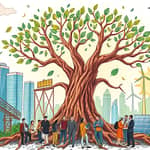
In an era of accelerating environmental pressures and social change, investors and leaders are called to rethink traditional models of economic growth.
Institutional investors and individual stakeholders alike must embrace a dual approach that integrates the stewardship of ecosystems with the empowerment of people. By recognizing the intertwined nature of growth and well-being, we can forge resilient economies capable of thriving in the face of uncertainty.
Natural capital constitutes the world’s stock of natural assets–forests, wetlands, soils, water bodies, biodiversity–that deliver essential ecosystem services over time. While traditional finance has often underpriced or ignored these assets, leading to degradation and risk, the emerging field of sustainable finance calls for a paradigm shift.
Despite its critical role, nature remains undervalued in many economic models. The degradation of soils and loss of pollinators already affects yields and supply chains worldwide. Restoring ecosystems thus becomes both an ecological imperative and a strategic financial decision.
Consider a mangrove restoration project that not only enhances carbon sequestration but also provides coastal communities with sustainable fisheries and flood protection. Such initiatives exemplify flow of ecosystem services that support livelihoods and climate resilience.
Each category of service anchors societies and markets, sustaining both livelihoods and biodiversity.
Tangible natural assets–timberland, farmland, wetlands restoration, blue carbon ecosystems–offer both financial returns and positive environmental impact. Historically, these assets have delivered real inflation-linked yields from timber harvests, crop sales, and rental income, alongside capital appreciation tied to land value.
A timber investment fund that realized 6% real annual returns while reforesting degraded land highlights the dual benefits of financial performance and ecological restoration. Similarly, wetland projects financed through green bonds have reduced flood risk for downstream communities, demonstrating systemic value creation.
Adding natural capital to a portfolio can enhance diversification, provide inflation hedging, and align with ESG mandates for climate and biodiversity impact.
Human capital–the collective skills, health, and knowledge of a population–drives innovation and long-term prosperity. Education, training, and healthcare are the pillars that elevate individual potential and catalyze economic development.
Globally, every dollar invested in early childhood education can yield up to $7 in economic benefits through higher productivity and reduced social costs. Investing in skills for green technology unlocks innovation and higher wages, fostering more equitable societies.
However, without proper disclosure frameworks, investors struggle to measure progress. CalPERS and Aon collaborate to establish common standards, advocating for transparent human capital accounting practices that drive accountability and value creation.
Developing countries rich in natural resources often face a paradox: abundant revenues but underinvestment in education and health. This “resource curse” manifests through currency appreciation, rent concentration, and weakened institutions, which disincentivize broad-based human capital accumulation.
In one country, oil revenues expanded healthcare access, boosting life expectancy by five years in a decade. Yet schooling outcomes lagged, as governance weaknesses diverted funds into subsidies rather than schools. This illustrates the delicate balance between resource wealth and social progress.
Contrast this with Korea, which redirected limited resources into universal education, achieving literacy rates above 97% by the 1960s and fueling export-led growth. It is a testament to the power of strategic investment in people driving rapid, inclusive development.
To maximize both natural and human capital, stakeholders should adopt integrated strategies that recognize their interdependence:
Through coordinated action, the compound benefits of nature restoration and human empowerment can unlock exponential growth and resilience.
We stand at a crossroads where decisions today will echo through futures yet unknown. Will we continue down a path of extraction and exclusion, or will we choose to invest in regenerating ecosystems and human potential?
The choice is clear: sustainable prosperity demands that investors and leaders adopt an integrative approach, valuing all forms of capital. By doing so, we not only safeguard the planet and uplift communities but also secure enduring returns that reflect true wealth.
Let this article serve as both inspiration and guide: with thoughtful policies, innovative financing, and a commitment to equity, we can cultivate a world in which natural and human capital thrive side by side, fueling a more just and vibrant society. Now is the time to sow the seeds of collective abundance.
References