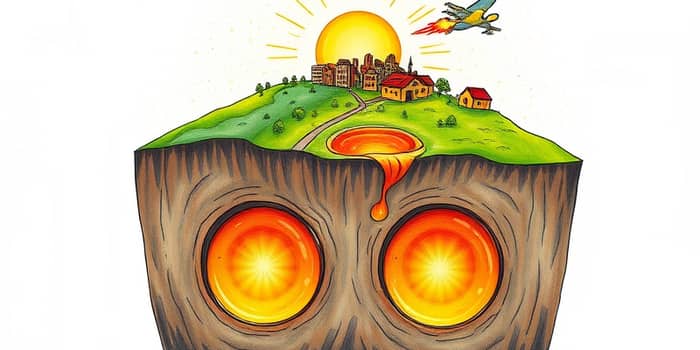
In an era of climate urgency and rising energy demands, geothermal energy emerges as a powerful yet underexploited resource. Beneath our feet lies a vast reservoir of heat that can reshape the world’s energy landscape, offering a path toward resilience, stability, and sustainability.
Geothermal energy is the thermal energy derived from Earth’s internal heat, generated by radioactive decay and residual heat from planetary formation. It exists in two main forms: high-enthalpy resources—such as volcanoes, geysers, and deep hot-water reservoirs—and low-enthalpy resources—moderately warm rock and shallow ground heat. While high-temperature sites fuel power plants, the more widespread low-temperature sources support heating, cooling, and industrial applications.
Despite its enormous theoretical potential, geothermal contributes only a fraction of global energy supply today. Yet advances in technology and growing policy support place it at the forefront of cost-effective clean energy solutions, primed to expand far beyond traditional volcanic regions.
Modern geothermal harnessing falls into three broad categories. Each technology taps Earth’s heat differently to deliver electricity, direct heat, or efficient climate control:
Power plants rely on steam or hot water extracted from hydrothermal reservoirs within a few kilometers of the surface. Three main designs prevail:
Dry steam plants use steam directly from underground to drive turbines, while flash steam plants flash high-pressure hot water into steam at the surface. Binary cycle plants couple lower-temperature geothermal fluid with a secondary working fluid, enabling power production from 100°C to 180°C resources.
Innovations in drilling and subsurface engineering have given rise to Enhanced Geothermal Systems (EGS). By fracturing hot but dry rock and circulating water through the engineered reservoir, EGS unlocks geothermal potential in regions once considered unsuitable. The first large-scale commercial EGS plant in Utah’s Fervo Cape Generating Station is slated to come online in 2026, heralding a new era of almost-anywhere geothermal power.
Geothermal energy extends far beyond electricity. Direct-use applications tap natural springs or shallow reservoirs to heat buildings, greenhouses, and aquaculture ponds, and to support industrial processes like food dehydration and mineral extraction. District heating systems in cities such as Reykjavík demonstrate the environmentally friendly solution geothermal can provide for urban warming.
Geothermal heat pumps exploit near-constant ground temperatures a few meters below the surface. By transferring heat to and from the earth, these systems can save homeowners 30–70% on heating and 20–50% on cooling costs compared to conventional HVAC systems. Their versatility makes them ideal for a wide range of climates and building types.
Despite growth, geothermal remains a small slice of global power. As of 2025, installed capacity reached approximately 17.2 GW across 35 countries, producing around 95 TWh of electricity in 2023. Yet this is just the beginning.
This capacity operates at a typical capacity factor of 90–98%, generating power for up to 8,600 hours per year. In contrast, solar output averages around 2,000 hours annually. This baseload, always-on power is crucial for grid stability and complements intermittent renewables like wind and solar.
Building a geothermal facility entails high upfront costs—particularly for drilling and exploration—but offers stable, low-variable operational expenses over decades. Levelized cost estimates for geothermal electricity range between $0.04 and $0.10 per kWh, competing favorably with other clean energy sources when accounting for reliability.
Geothermal power emits less than 5% of the CO₂ footprint of a natural gas plant and negligible particulates or sulfur compounds. Direct-use heating replaces coal, oil, or gas boilers, cutting emissions by thousands of tons annually for a single district system. Far from an experimental technology, geothermal today is an established pillar of clean energy strategy.
Key hurdles remain. Geothermal development is capital-intensive and geographically constrained by resource location. Exploration risks and drilling costs can deter investors. Water usage and induced seismicity concerns, especially for EGS, demand careful management and community engagement.
Addressing these challenges opens the door to tapping vast untapped reservoirs of heat, potentially delivering hundreds of gigawatts of new capacity worldwide within decades.
Policy incentives, research funding, and industry collaboration are coalescing around geothermal’s promise. The U.S. Department of Energy estimates up to 100 GW of accessible geothermal potential in the continental United States—nearly ten times current capacity. Worldwide, Enhanced Geothermal Systems could unlock up to 727 GW of cost-effective power if fully realized.
As nations seek reliable, carbon-free energy, geothermal offers a unique combination of unlimited clean power, grid resilience, and direct heat applications. By investing in exploration, innovation, and sustainable practices, we can transform this “untapped wealth” into a cornerstone of a resilient energy future—providing warmth, electricity, and opportunity for generations to come.
Embrace the heat beneath your feet. Champion geothermal energy today, and help build a brighter, cleaner tomorrow.
References