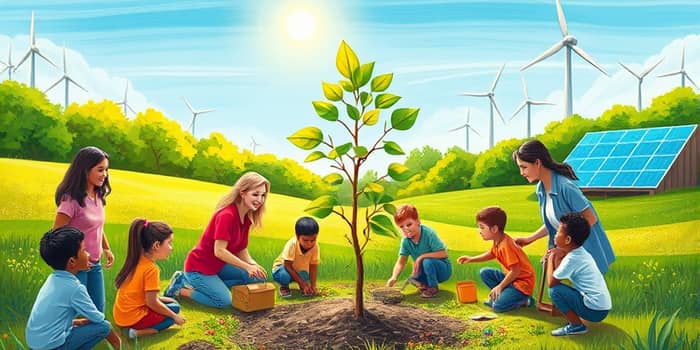
The accelerating climate emergency demands more than technical fixes and policy debates. At its core lies a profound human challenge: equipping every learner with the understanding, skills, and drive to shape a sustainable future. Education is the foundational tool for driving the transformational change required in our societies and economies.
By investing in comprehensive climate education, governments, institutions, and communities can cultivate a new generation of climate-literate citizens and professionals. These individuals will not only pursue careers in renewable energy, sustainable agriculture, and green finance but also adopt everyday practices that reduce carbon footprints and build community resilience.
Climate change education (CCE) goes beyond textbook knowledge. UNESCO emphasizes that CCE “helps people understand and address the impacts of the climate crisis, empowering them with the knowledge, skills, values and attitudes needed to act as agents of change.” International agreements like the Paris Agreement and the UNFCCC’s Action for Climate Empowerment agenda call on nations to embed CCE within education systems at all levels.
Effective climate education is a key enabler of the global climate response. It fosters awareness, drives behavioral change, and equips future generations with competencies to innovate low-carbon solutions. From encouraging cycling and plant-based diets to promoting home energy efficiency, CCE yields both environmental and economic gains for individuals and societies.
Research from NAAEE’s Climate Change Education synthesis and Teachers College, Columbia University, highlights core ingredients for impactful learning:
These features anchor climate concepts in tangible experiences. When students conduct local energy assessments or restore native vegetation, they develop practical problem-solving skills and a profound sense of agency. Continuous professional development for educators ensures they stay current with evolving science and pedagogies.
Investing in climate education yields multiple “win-win” outcomes. According to Take Action Global, CCE can reduce CO₂ emissions at a lower cost per ton than many technological interventions while nurturing a workforce ready for the green transition.
In the United States, over 86% of teachers and 84% of parents support climate education in schools. This broad backing underscores the demand for curricula that foster civic engagement and prepare learners for participation in democratic processes around sustainability policy.
Despite strong support, significant gaps persist. In the UK and Europe, about 80% of students want more sustainable development content, yet only 4% feel they know a lot about climate change. Teachers report insufficient training, lack of resources, and hesitancy in addressing controversial topics.
Globally, UNESCO’s GEM Report reveals that 62% of countries lack national-level laws or strategies for climate education. Shockingly, just 0.03% of climate finance reaches education initiatives. In the Global South, where climate impacts are most severe, this funding shortfall exacerbates vulnerability and hinders workforce development.
Collaboration between governments, NGOs, and educational institutions can close these gaps. NGOs bring technical expertise for curriculum design and teacher training, while policymakers establish the legal and funding frameworks essential for large-scale implementation.
The emerging climate or green workforce encompasses a spectrum of roles crucial for achieving net-zero targets and adapting to climate impacts. TIP Strategies identifies positions in renewable energy, sustainable transportation, low-carbon manufacturing, and ecosystem restoration.
Training pathways—from vocational programs to university degrees—must align with labor market needs and local contexts. By integrating CCE into early education, career and technical training, and adult learning, societies can nurture talent pipelines that drive innovation and resilience.
To transform vision into reality, stakeholders can take concrete actions:
Monitoring and evaluation frameworks ensure accountability. Collecting data on learning outcomes, behavior change, and job placement helps refine programs and demonstrate returns on investment.
Investing in climate education is an investment in our shared future. It empowers individuals with green skills for the 21st century and forges the workforce needed to confront the climate emergency. By bridging policy gaps, harnessing innovative teaching, and channeling resources where they matter most, we can cultivate a generation of changemakers ready to lead the transition to a resilient, equitable, low-carbon world.
Now is the time to act. Governments, educators, businesses, and communities must unite to elevate climate education from an aspiration to a global norm. Together, we can turn knowledge into action, ambition into achievement, and hope into tangible progress for people and planet.
References