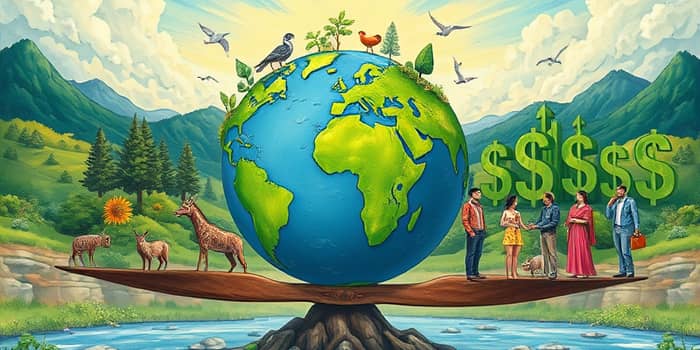
Humanity stands at a crossroads. Traditional measures of prosperity ignore a growing hidden debt—degraded ecosystems and lost biodiversity. By reframing nature as a vital asset, we can transform restoration into a powerful engine for economic growth, social wellbeing, and climate resilience.
Degradation of forests, wetlands, soils, and reefs represents a massive hidden liability on humanity’s collective balance sheet. Yet, each act of restoration yields outsized returns: economic, social, ecological, and climatic. This article explores how a One-Earth Balance Sheet, where natural capital is fully accounted, can unlock unprecedented dividends.
A One-Earth Balance Sheet integrates financial, environmental, social, and governance data into a unified asset-liability ledger. It recognizes:
Humanity currently consumes the equivalent of 1.6 Earths, systematically depleting natural principal. Meanwhile, more than half of global GDP—around USD 44 trillion—is moderately or highly dependent on nature’s work. Ignoring these exposures is akin to concealing a mounting financial crisis.
Restoration projects deliver remarkably high benefit-cost ratios. The UN Environment Programme and US EPA estimate that each USD 1 invested in ecosystem restoration generates between USD 3 and USD 30 in economic benefits. In the United States alone, restoration activities produce over USD 24 billion in annual economic output and support more than 221,000 jobs.
These figures underscore that restoration is not a philanthropic side quest but a high-return investment rivaling major infrastructure projects. Consider the Comprehensive Everglades Restoration Plan (CERP): completing the plan promises benefits of approximately USD 46.5 billion and more than 440,000 jobs over time, with roughly 19 jobs created per USD 1 million spent.
Degraded ecosystems magnify climate extremes, intensify disaster costs, and undermine food security. Restoring just 15% of converted lands—and halting further conversion—could avoid around 60% of projected biodiversity extinctions and deliver over one-third of the climate mitigation needed by 2030.
Natural capital restoration thus functions as global insurance, reducing systemic risk much like de-leveraging an over-indebted balance sheet. Agroforestry alone can improve food security for 1.3 billion people. Wetland and mangrove rehabilitation sharply reduce flood damage and support fisheries that generate USD 3 billion annually.
Failure to act risks up to USD 10 trillion in lost global GDP by 2050—the equivalent of a massive sovereign default on nature’s bond.
Beyond measurable GDP gains, restored ecosystems yield vital health and social benefits. Cleaner air and water reduce disease burdens. Access to green spaces enhances mental health and encourages physical activity.
Restoration projects revitalize local economies, especially in post-industrial or rural regions. Forestry, conservation engineering, civil green infrastructure, and ecotourism provide diverse job opportunities, rebuilding social capital and cohesion while preserving cultural landscapes.
The momentum behind nature-based accounting is growing. Companies and governments are developing nature balance sheets to value the assets they depend on and the liabilities they incur through degradation. This approach compels organizations to:
Emerging instruments—such as Nature Asset Purchase Agreements—create a new equity class for natural capital, allowing investors to acquire stakes in carbon stocks, biodiversity corridors, water basins, and healthy soils. Geospatial monitoring ensures accountability, tracking changes in biomass, forest cover, and soil moisture.
By integrating natural capital into ESG reporting and financial disclosures, companies expose hidden risks, unlock new revenue streams like carbon credits and resilience premiums, and redirect capital toward restoration-aligned projects. In essence, we shift from exploiting an unseen balance sheet liability to profiting from a growing natural capital asset.
Ultimately, viewing restoration through a financial lens reveals a profound truth: investing in planetary health is not a cost—it is the most reliable path to sustained prosperity. By settling our ecological debts and capitalizing on nature’s assets, we can craft a future where economic growth, social wellbeing, and a stable climate flourish in harmony.
References