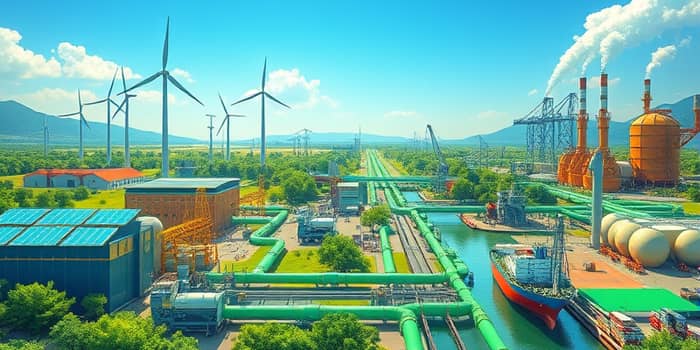
The world stands at the cusp of a transformative era. Driven by the relentless need for decarbonization and the promise of sustainable growth, green hydrogen is emerging as the linchpin of a new industrial paradigm. By harnessing renewable energy to split water into fuel, societies can unlock unprecedented opportunities for clean manufacturing, resilient supply chains, and global energy security.
At its core, hydrogen is an energy carrier and industrial feedstock, not a primary source. It must be produced using other energy inputs. When that production is powered by solar, wind, or hydroelectricity, the result is near-zero direct-emissions fuel—commonly called green hydrogen. This contrasts sharply with traditional “grey” hydrogen (from fossil fuels) and “blue” hydrogen (from fossil fuels with carbon capture).
Today, green hydrogen makes up only about 0.1% of global hydrogen output, but its potential is vast. It can decarbonize hard-to-abate sectors like steel, cement, shipping, and aviation, while also offering a scalable method to store and transport renewable energy across distances and seasons. By reducing reliance on imported fuels, it promises to bolster energy sovereignty and stimulate new domestic industries.
The broader hydrogen market—encompassing grey, blue, and green—was valued at roughly USD 214.7 billion in 2025, poised to reach USD 380.1 billion by 2035. This growth largely stems from existing uses in ammonia synthesis, oil refining, and methanol production. However, the carbon footprint of conventional hydrogen remains high, with significant CO₂ emissions from steam methane reforming and coal gasification.
Transitioning these established applications to low-carbon hydrogen represents one of the largest mitigation opportunities available. Shifting the annual 70 million tonnes of grey hydrogen production to green would avoid hundreds of millions of tonnes of CO₂ emissions, setting the stage for broader energy-system overhaul.
All major analysts forecast meteoric growth for green hydrogen, although estimates vary by scope and methodology. Current market values hover between USD 6.5 billion and USD 12.3 billion in 2025. By 2035, projections range from USD 115 billion to USD 231 billion, reflecting compound annual growth rates of 30–57%.
Such forecasts underscore the narrative of a solar-hydrogen economy successor that could replace 12 billion tonnes of oil equivalent per year with green hydrogen, igniting what many call the greatest social and economic transformation of our time.
Central to this revolution are electrolysers that split water into hydrogen and oxygen. Three distinct technologies dominate:
Beyond hardware, digital innovation is vital. AIoT systems and digital twins optimize plant design, predict maintenance needs, and integrate variable renewables with the grid. These tools can reduce CAPEX and OPEX by up to 25%, accelerating commercial viability by as much as seven years.
While green hydrogen can retrofit existing processes in fertilizer, refining, and chemicals, its true transformative power lies in emerging uses:
By extending green hydrogen into these domains, entire industrial value chains can flip from polluting to regenerative.
Governments worldwide are adopting ambitious hydrogen strategies, offering subsidies, carbon pricing, and procurement mandates. The European Union, Japan, and Australia have all earmarked tens of billions in public funding, while China’s five-year plans integrate hydrogen into national energy goals.
Infrastructure investment is equally critical. Expanding renewable electricity capacity, building large-scale electrolysis plants, and developing hydrogen pipelines and storage facilities will require collaboration across public and private sectors. Strategic siting of hubs near renewable-rich regions and heavy industry will catalyze cluster dynamics and reinforce local economies.
Currently, green hydrogen production costs range from USD 4 to USD 6 per kilogram, depending on electricity prices and scale. Projections suggest costs could fall below USD 2 per kilogram by 2030 through economies of scale and technology innovation. Market competitiveness hinges on continued cost declines and supportive policies.
However, risks remain. Supply chain constraints for critical materials, regulatory uncertainty, and potential market oversupply could stall growth. Mitigation strategies include recycling of catalyst materials, long-term offtake agreements, and phased infrastructure rollouts to balance supply and demand.
In an optimistic scenario, global policies align, innovations accelerate, and green hydrogen reaches scale by 2035, underpinning a net-zero economy by mid-century. In a more moderate path, growth continues but at a slower pace, delaying full decarbonization until after 2050. A pessimistic outlook envisions policy backsliding and stranded assets, leaving hydrogen marginal.
Ultimately, the trajectory depends on collective action. Companies, governments, researchers, and communities must collaborate to unlock the self-reinforcing benefits of a hydrogen economy: self-reinforcing growth once certain scale is achieved, driving down costs and spurring innovation.
Green hydrogen is more than a new fuel—it is the spark for the next industrial revolution. It offers a path to cleaner skies, sustainable manufacturing, and resilient economies. By investing in technology, infrastructure, and policy today, society can ensure a legacy of prosperity, innovation, and planetary stewardship for generations to come.
References