From the melting ice caps to widening income gaps, today’s crises are interconnected in a way we’ve never seen before. Our future depends on reimagining how economies function—placing both people and the planet at the heart of every decision.
The 21st century has ushered in what scholars call a global polycrisis of interlinked threats. Climate change amplifies extreme weather, inequality tears at social cohesion, and biodiversity loss undermines the very systems that sustain us. Meanwhile, traditional economics treats nature as an external factor, assuming infinite growth on a finite planet.
We must shift from extractive growth models to regenerative prosperity—ensuring that economic activity enhances both human wellbeing and ecological health within planetary boundaries.
Drawing on the Club of Rome’s ten principles, six core pillars form the backbone of this new economic paradigm:
These pillars guide policy makers, businesses, and civil society toward an economy that serves all life, not just profit margins.
The Ellen MacArthur Foundation defines a circular economy as one where materials never become waste and nature is regenerated. It rests on three design principles:
First, eliminate waste and pollution by rethinking production. Second, circulate products at their highest value through maintenance, reuse, and recycling. Third, regenerate nature by restoring soils, building biodiversity, and investing in ecosystem services.
By decoupling economic activity from resource depletion, a circular economy offers a pathway to grow prosperity while cutting pollution.
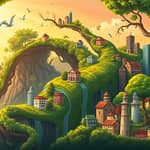
Nature offers the ultimate blueprint: there are no landfills in the wild. Biomimicry—emulating natural processes—can guide materials, infrastructure, and urban planning. Cities can become living systems that absorb rainwater, filter air, cycle nutrients, and support wildlife.
Case studies show that nature-positive circular cities boost local economies by creating green jobs, reducing energy costs, and enhancing public health. By weaving parks, green roofs, and urban forests into the cityscape, we build resilience against climate shocks.
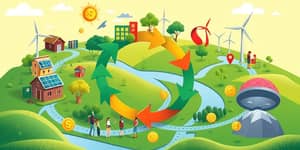
The Prosperity Loop™ offers a concrete institutional model for a regenerative, fair economy. Inspired by energy cycles in ecosystems, it keeps money and resources flowing through communities, ensuring everyone benefits.
This fiscal framework internalizes ecological costs, distributes value equitably, and maintains regenerative resource circulation.
Ecosystem scientists highlight three drivers of resilience: diversity, energy flow, and mutualistic exchange. Translating these to economics means fostering diverse industries, investing in renewable energy infrastructure, and creating trade networks based on cooperation rather than extraction.
A diverse economy weathers shocks better, local renewable power builds self-reliance, and equitable trade strengthens social bonds. Together, these principles create an economy in harmony with resilient ecosystems.
Some argue, based on the Environmental Kuznets Curve, that economic growth automatically cleans up pollution once societies become wealthy. Yet this pattern fails for global pollutants like CO₂ and overlooks structural inequities.
A new economics perspective warns that unchecked growth can push us past critical ecological tipping points. Instead, we must actively design economic systems that respect planetary boundaries and center wellbeing from the outset.
By piloting circular districts, incentivizing nature-based solutions, and sharing best practices globally, we can scale this blueprint swiftly.
Designing economies for thriving ecosystems is no longer a visionary luxury—it’s an urgent necessity. By embedding wellbeing, respecting ecological limits, and mimicking nature’s intelligence, we can forge a path toward regenerative prosperity. The blueprint is at our fingertips. It’s time to build a future where every economy nourishes the planet and uplifts every person.
References